
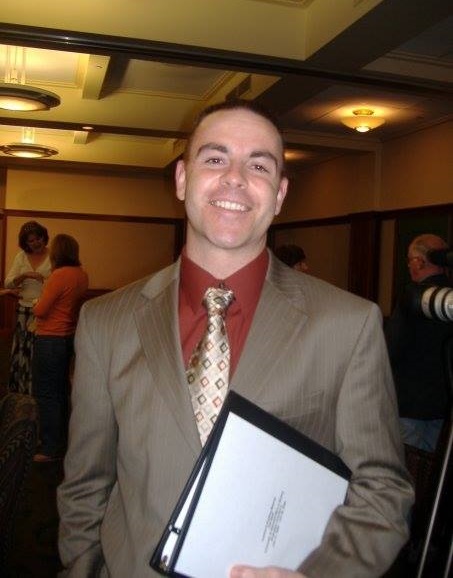
It was September, 2002.
I was walking across campus toward my car in the lot on the other side of Denison Avenue when I met Professor Dave Smit walking in the opposite direction. He was the Director of the Expository Writing Program, and I was one of the English Department’s new contingent of graduate students teaching English 100 for the first time. He seized the opportunity of this chance meeting to teach me a lesson that shapes what I do to this day:
“How is class going?”
“Great!” I said. “We had a great discussion yesterday.”
“Did they learn anything?”
Dave would soon become my major professor. He knew when to “push me around,” as he liked to describe it. He knew then what I know today as Professor of English at Doane University in Crete, Nebraska.
I didn’t yet know what I didn’t know. One of the myriad things I didn’t yet know was this: there are things that feel good in the classroom and there are things that DO good. Spend your time and energy on the latter, even if you find yourself doing things differently from the rest. Do the work, hone your craft, and learn enough to have confidence enough to defy conventions.
I left Manhattan two years later with a master’s degree and the Graduate Certificate in Technical Writing and Professional Communication. More importantly, I carried with me the agency to do for others what the professors in the Kansas State English Department did for me. Indeed, everywhere I look today, I see lessons from my time at Kansas State, the people and experiences that shaped who I am today, what I do, and why.
I am now the chair of the English Department at Doane. Our English and Writing program bears little resemblance to the curriculum I found when I arrived in the fall of 2005. Times have changed, and so must we. When I took over as chair a couple years ago, my colleagues and I set out to reimagine what we do for our students by asking this question: why do stories matter beyond the page? It turns out that to know how stories work on the page is to know why stories matter beyond it. This exploration gave us the confidence to break with traditions that no longer served the needs of our students. We also recently created five new interdisciplinary certificates: Narrative Medicine; Land and Literature; Gender, Identity, and Sexuality; Data Storytelling; and Sports in Literature and the Liberal Arts. This fall, we are revising several courses to explore the creative applications of artificial intelligence (AI) and prepare students more intentionally to operate in a wide range of fields that now demand generative AI literacy.
Last May, at our annual honors convocation during commencement weekend, I received the Thomas Doane Outstanding Faculty Award in 2024. That honor now occupies a shelf with the Student Congress Teacher of the Year Award I won in 2010. Just above them sits my diploma from Kansas State. I will be forever grateful that Dave Smit and so many others cared enough to push me around.
— Philip Jude Weitl (MA ’04)
Philip Jude Weitl is Professor of English at Doane University, where he earned the Thomas Doane Outstanding Faculty Award in 2024 and the Student Congress Teacher of the Year Award in 2010. He is the current chair of the English Department and past holder of the Ardis Butler James Endowed Chair. He created and directed The Writing Center at Doane from 2008-2013 and now directs The New Xanadu (mytnx.com), a multimedia reimagining of the school’s literary magazine since 1956. He also leads the English Department’s dual-credit pathway and serves on two task forces: one created to revitalize Doane’s liberal arts mission and the other working toward an interdisciplinary approach to AI for faculty and students, both on campus and beyond. Previously he served on a task force that designed and implemented the Doane Core, the university’s current general education curriculum. He earned a Master of Fine Arts in Creative Writing from the University of Nebraska as well as a Master of Arts in English and a Graduate Certificate in Technical and Professional Communication from Kansas State University. His writing has been recognized by literary magazines around the country, as well as the prestigious Best American Essays anthology series. Prior to his academic career, he worked as a campaign field operative and then Speechwriter and Deputy Press Secretary for the Nebraska Governor’s Office.
 K-State English