

I was hired as an events coordinator two days before the world ended.
Yes, I’m being a bit dramatic, but only slightly. In March 2020, I was working as an administrative assistant to two deans in the College of Arts and Sciences at K-State, and I was ready for a change.
My husband and I had already decided to move back to our hometown of Lawrence several months before. I had applied to any administrative assistant or event planning positions in the Lawrence or Kansas City area that I could find. Finally, one position stuck.
Greenbush isn’t a well-known company unless you work in a rural school district. They specialize in districts that can’t afford to create their own PD (professional development) and even design hands-on learning opportunities for kids at their main campus in Girard, Kansas. Their Lawrence office, located at the old Wakarusa Elementary School, was looking for a Hospitality and Programs Coordinator.
The second I walked away from the interview, I knew I had the job in the bag. Although I had minimal event planning experience from my time as a restaurant manager at a retirement community, I felt confident I could learn the skills on the job. Sure enough, the Friday after my interview, I got the call. My family and I went out to celebrate—we were one step closer to being where we wanted to be!
Two days later everything shut down due to the coronavirus.
In a panic, I contacted my supposedly new supervisor to ask if I still had a job. After all, how does a program coordinator coordinate programs if we can’t even be within six feet of each other? It took some time and trial and error, but eventually, we came up with a new use for me. Communications Director.

Emma Herrman working from home in 2020 with co-worker Bruno
I wouldn’t say it was a disaster, but it was obvious I was unprepared for what comms and marketing entailed and that the company didn’t know what they wanted from me either. The only experience I had was my own personal social media platforms and a gut feeling of how I thought our audience would react to what we were posting. I didn’t know how to find the data to back it up or how to leverage our strategy to grow our new brand and reach new audiences. After many learning experiences and some frustrating interactions, I decided that gut reaction wasn’t enough anymore and Greenbush and I parted ways. That was when I decided to start looking into graduate programs.
Obviously, I bleed purple. I visited K-State during my junior year of high school as part of a journalism workshop and fell in love with the campus and community pretty much from the beginning. After I graduated in 2016 with my English degree, my husband (an Education graduate!) and I stayed in Manhattan for four more years because we loved the people we had befriended and the growing town. So, looking into a master’s program at KU was a little difficult for me.
I met with the director of the Digital and Integrated Marketing Communications (DIMC) program, Matt Tidwell, over Zoom one afternoon and we talked for about an hour about the program and what it would all entail. If I joined the program I would have the opportunity to not only graduate in two years with a master’s degree, but I could also complete a social media certificate at no extra cost. The program would touch on everything that I had struggled with before — cultivating data that could tell a story for shareholders, developing a social media strategy that could reach new audiences, and other strategies I hadn’t even considered. Like, did you know that all companies should have intricately detailed crisis communications plans in case of an emergency? I didn’t! But now, a year after taking the Crisis Communications course, I know all about how and why they’re important. (By the way, if you’re interested in what NOT to do in a crisis, watch the VW Diesel scandal episode of Dirty Money on Netflix.)
I had missed working in a college environment during my time at Greenbush. One of my favorite parts of working at the College of Arts and Sciences was helping students move toward graduation and hearing the unique stories they had to tell. When I started my next job search, I focused on communications jobs within KU.
I joined KU Law in 2022, knowing I wanted to join the DIMC program. Much like K-State, KU offers employee tuition benefits after the six-month probation period after hiring expires. During that time I asked questions, spoke with other comms leaders throughout campus, and worked to grow my marketing skills through hands-on learning experiences.
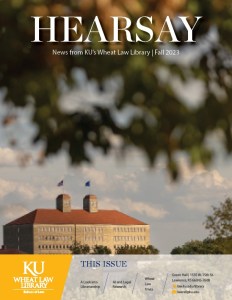
One of Emma’s projects in 2023 which she designed from front to back.
By August 2023, I was excited to start the program. Since then, I have started another new opportunity developing the Outreach and Communications Coordinator position within the School of Engineering — a position I earned partially because of my progress in the DIMC program. I finish up my capstone project working alongside a real company developing new marketing strategies for them this spring and plan to walk at graduation this May.
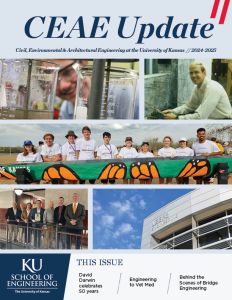
Cover for a 2024 newsletter, designed by Emma, for KU’s School of Engineering
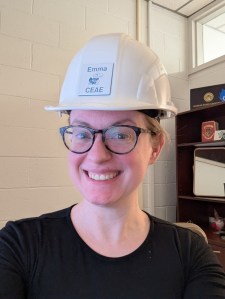
Emma celebrating National Hat Day with KU’s School of Engineering
Though I have learned so much in my time in the DIMC program, I can’t deny that I have also learned so much more just from my interactions with other professionals. I have learned how to forge lasting relationships with alumni that have helped me further the mission of the departments I work for within KU, but I have also learned patience, independence, and flexibility as well as honing my creativity to be able to show the work our students have been doing to a wider public. I graduated from the English Department in 2016, not knowing if I’d even be doing a job where I’d get to use this degree. I have found my way into developing my degree into something so much more meaningful to me and the community around me.
— Emma Herrman (BA ’16)
 K-State English