
Last night, I sat on my bed with the windows open, it was the first chilly Fall evening of the year. I’d felt the crisp air sliding over my skin and gently fluttering the pages of my reading journal.
I was finishing filling in my September reads, where I took a moment to reflect on the literature I’d read this year and reminisce on what each one had left behind on me. From historical speeches like “Powhatan’s Discourse of Peace and War” (1609), the generational trauma and systemic racism discussed in August Wilson’s Fences (1983), and Michelle Zauner’s moving memoir about grief and her struggles with her Korean-American identity in Crying in H Mart (2021), I realized that the goosebumps on my skin weren’t a product of the autumn air anymore. I thought, “How appreciative am I to read stories that open and challenge my perspective on a variety of cultures, experiences, and frames of thought?”
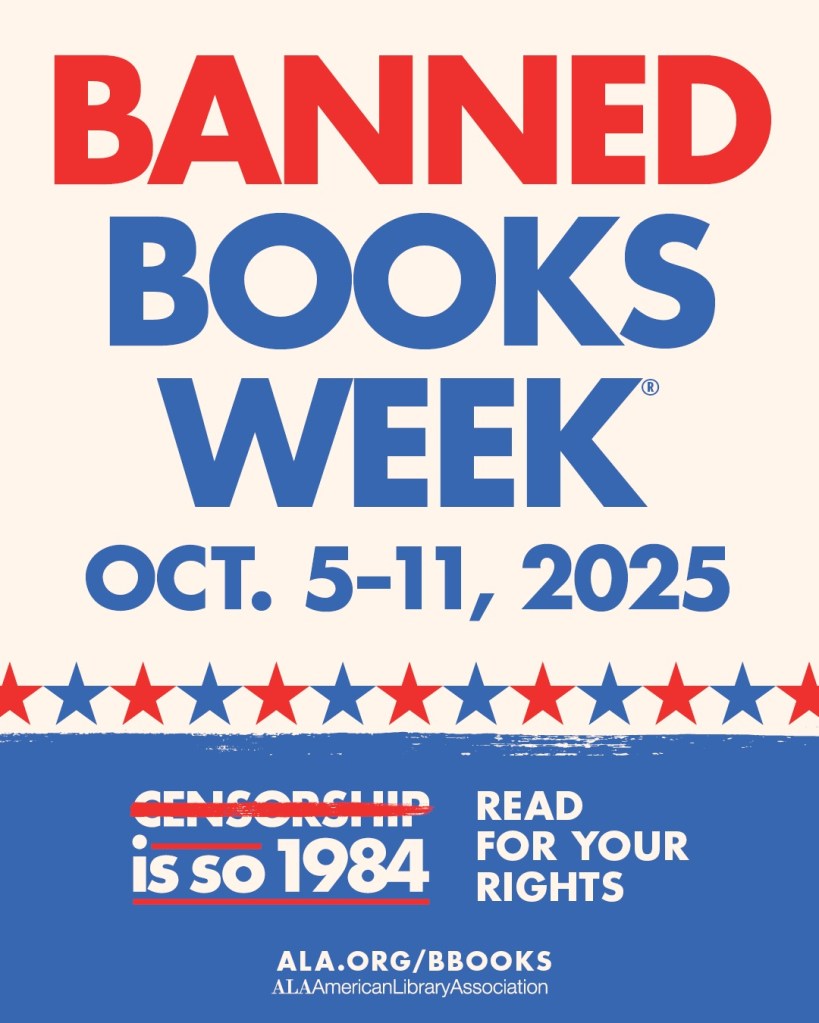
Then, with Banned Books Week quickly approaching, my feelings of fortune shifted to fear: “What if these diverse, daring stories that helped shape me and the culture I’m a part of were taken off the shelves and hidden from public display?”
History shows that my fears weren’t irrational.
It’s well known that the censorship of books has been a constant battle since the beginning of publishing. Influential novels like 1984 (1949), The Handmaid’s Tale (1985), and The Hunger Games (2008)—books that challenge oppressive societal standards and systems—were eventually removed from the educational sphere.
We must face the reality that book bans aren’t only remaining consistent, but they’re continuing to grow at a rapid pace. In 2024, ALA, or the American Library Association, traced 821 attempts to redact library materials and services, collectively challenging a total of 2,452 unique titles. Though this number is less than the year before, “the number of documented attempts to censor books continues to far exceed the numbers before 2020” (“Book Ban Data“).
We’re left with one question, then: “What do we do?”
Read, absorb, share, and write about every story that’s meaningful to you. Don’t let books with crucial topics like race, gender, sexuality, and oppression become a memory, especially for students who resonate and learn so much from these narratives.
This week, K-State is hosting its annual Banned Books Week event, Monday (10/6) through Friday (10/10), 12:30-1:30 pm, at the Hale Library Living Room (right of 2nd floor entrance). Come join the university in learning more about the movement, finding community, or simply taking a moment to appreciate these celebrated, yet restricted, works of literature.
Read the novels that challenge and inspire you, support local bookstores, and don’t let these stories get erased.
If you’re interested in learning more about banned books, check out the ALA website.
— Jaidyn Koehler, Sigma Tau Delta Historian (BA ’27)
 K-State English