
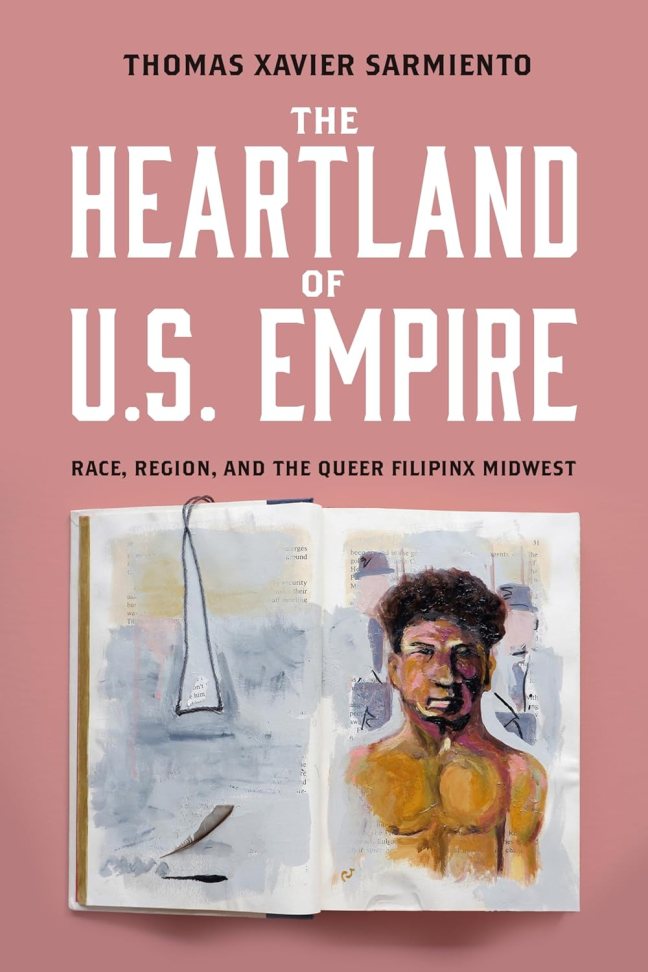
“‘Flyover country’ is not as bland as you might think,” argues Associate Professor Tom Sarmiento in his new book, The Heartland of U.S. Empire: Race, Region and the Queer Filipinx Midwest (Temple Univ Press, 2026). Sarmiento here offers a new, and not bland, narrative of America’s heartland and the U.S. Filipinx diaspora, one that places queerness, Filipinxs, U.S. imperial history, and the Midwest in dialogue with one another.
Sarmiento’s book was celebrated at a special session of this year’s Association for Asian American Studies (AAAS) annual conference devoted to The Heartland of U.S. Empire. Fellow scholars in the fields of Asian American literature, Queer Studies, history, and literary studies offered appreciation for the book, which, as one respondent put it, “not only expands the terrain of Asian American studies, but also asks us to rethink the spatial and ideological foundations of U.S. American identity itself.”
As students of “Dr. Tom” will not be surprised to learn, the book began with his personal response to a text: “In the fall of 2010, I decided to watch an episode of Glee. My first episode was the season two premiere, which featured a character named Sunshine Corazon, a new exchange student from the Philippines. As a queer Filipinx person, I reveled in watching a Filipina belt out lyrics to Lady Gaga and Beyoncé’s sapphic anthem ‘Telephone.’ I was already a fan of the actor playing Corazon, Jake Zyrus, because of his single ‘Pyramid,’ recorded under the name Charice. After this episode, I wanted to see more. Backtracking to season one, I learned that the show was set in Ohio and the high school was named after President William McKinley. I found it ironic that a Filipina exchange student was enrolled at a high school named after the person responsible for the annexation of her country in 1898. More puzzling was her presence in the middle of the country—a place not readily associated with Filipinx America.”
Thus began Sarmiento’s scholarly inquiry into the nexus of race, gender, sexuality, nation, diaspora, and empire, as imagined through the Midwest.
What resulted from this exploration is a rich, multi-disciplinary examination of literary, television, and archival writings. As respondent Sony Coráñez Bolton (Professor of English & Spanish and Chair of Latinx and Latin American Studies at Amherst College) noted at the AAAS panel, “what Sarmiento does so effectively, is to show that the heartland is not empty, nor is it merely the backdrop to a pastoral national myth. Rather, it is structured by migration, racialization, labor, and imperial entanglements—especially through Filipino American histories.”
Fellow panelist Kong Pheng Pha (Assistant Professor of Gender & Women’s Studies and Asian American Studies at the University of Wisconsin-Madison) described the ways that this revision transforms both our ways of thinking about the Midwest and our ways of thinking about Asian America: “Since the west and east coasts have long dominated how we think about Asian Americans, a Midwestern focus problematizes how Asian American communities form, how they are racialized, and how they enact solidarity and resistance across a range of geographies. I am struck by Sarmiento’s readings of Galang’s short story collection Her Wild American Self and Pamatmat’s play Edith Can Shoot Things and Hit Them, especially how the characters are able to discover themselves as queer while crafting home in the Midwest.”
One of Sarmiento’s strengths in the book is his “truly interdisciplinary and multidisciplinary” approach, added Pha, in appreciating the book’s weaving together of “archival research and museum and exhibit visits, semi-autobiographical approaches, and media and visual cultural studies approaches.” Sarmiento’s archival research not only excavates primary texts but also models a method of meta-analysis of the archive itself. As historian Genevieve Clutario (Associate Professor of American Studies at Wellesley College) noted in her remarks, “Sarmiento takes a deep dive and close look into the archival repositories that house the papers and ephemera of empire. For many historians, we often do not question the process of collection or the backstory of the archive itself. But for Sarmiento, the establishment of one of the largest holder of records of U.S. empire in the Philippines, the University of Michigan, is a story of an empire building in and of itself.”
The Heartland of U.S. Empire provocatively queers both ends of the U.S. imperial project. If that project has historically imagined itself as moving from a homogenously imagined “heartland” to extraterritorial spheres of influence, Sarmiento’s alternative narrative refuses both the homogenous heart and the offshore imperialism. Bolton summarizes this reimagining of the Midwest: “the heartland becomes a space in which Filipino Americans can claim the United States as home—not as a site of assimilation, but as a site of struggle, presence, and transformation.”
Sarmiento himself articulates that this is not just a matter of reimagining who is (or can be) at home in the heartland, but is a matter of making over the imaginary homeland itself: the Heartland of U.S. Empire is “a home renovation project that queers the joists, frames, and trusses that prop up America’s heartland mythology by highlighting its normative aesthetics and its role in engendering queer subjects who must appear out of place for the myth to hold.”
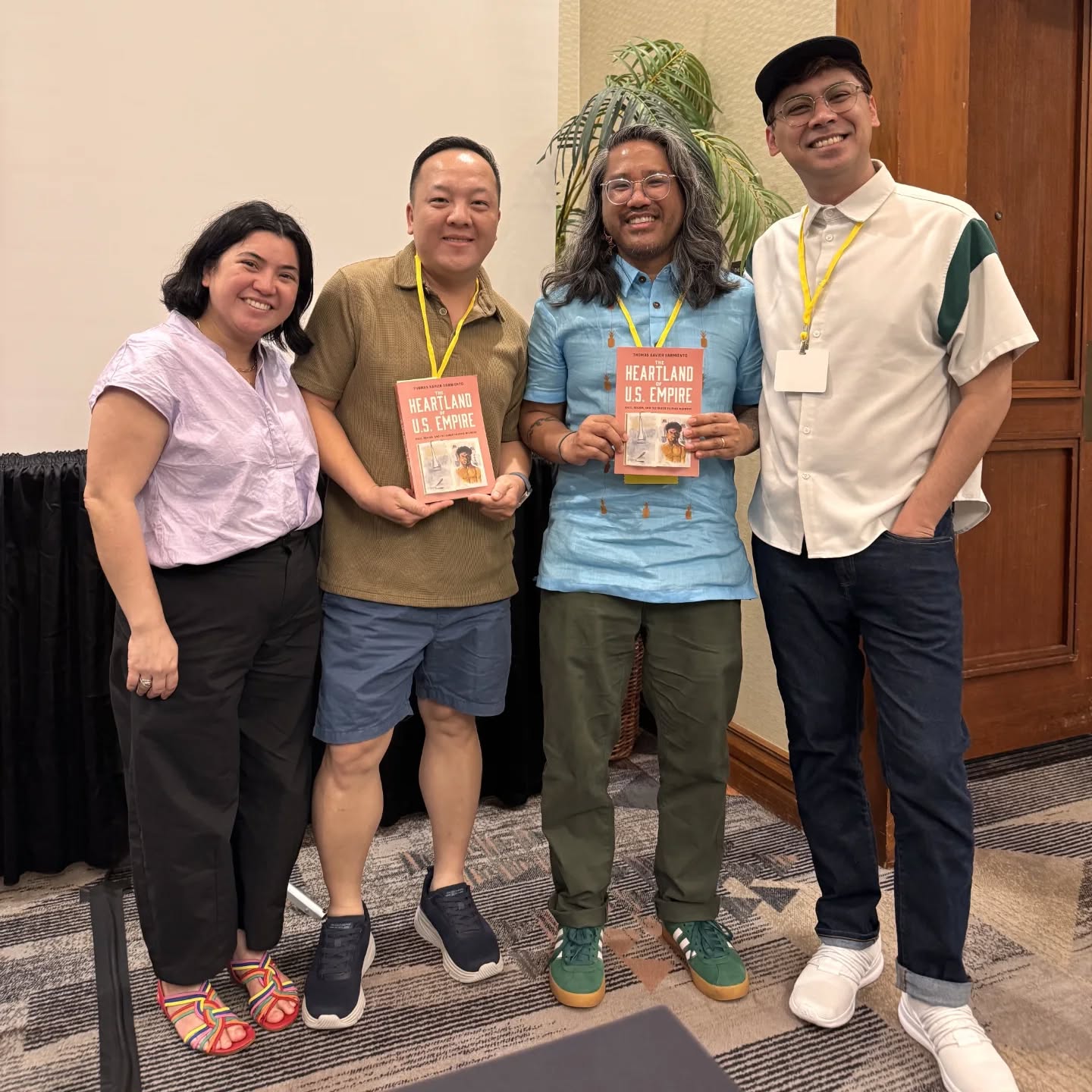
Genevieve Clutario, Kong Pheng Pha, Tom Sarmiento, and Sony Coráñez Bolton celebrate the launch of The Heartland of U.S. Empire at the 2026 Association for Asian American Studies conference.
— Michele Janette, Professor

