Spring 2023 launched a new environmental literature course, “Wild Lit.”
How have American writers viewed the more-than-human world over the centuries? What role has public land played in the American traditions of nature writing and environmental literature? How do the ethics of land use contribute to human-centered narratives? How have marginalized groups engaged with and shaped land policy? What role can humor play in literature of the Anthropocene? How has the study of ecology contributed to contemporary poetics? And: What time do you have to get up in the morning to see prairie chickens do a mating dance on Konza prairie?
These were some of the questions this course explored.
We opened the semester with a study of field journals, beginning with Henry David Thoreau—who kept some 47 volumes over his too-short lifetime!—and continuing through examples by 19th century writer Susan Fenimore Cooper (yep, daughter of the James Fenimore Cooper who wrote mile-long novels), Theodore Roosevelt (who published his first book, a checklist of birds of the Adirondacks at age 17), Joseph Bruchac (better known for his careers as both a Native American performing storyteller and an author of children’s books), and a Canadian biology professor, Dr. Lyn Baldwin (who regularly publishes work that derives from her own field journaling). Dr. Baldwin also made a Zoom visit to class to coach students in how to get started with an illustrated journal, with tips like how to convert an old breath mints tin into a portable watercolor kit.
Exploring the intersection between the environmental humanities’ concept of the Anthropocene and the observational work of ecologists, we read about how the details in Thoreau’s journals allowed researchers to demonstrate that, owing to climate change, the warming temperatures now lead trees near Walden Pond to leaf out more than two weeks earlier than was the case in Thoreau’s time.

Week by week, students made a practice of recording what they saw happening in the natural world.
Some noted the enthusiasm of robins gobbling down smashed crab apples that lay fermenting just south of Caldwell Hall on campus; others recorded observations from locations they visited for field work in other classes.
One, who may have been the instructor in an example post, noted the kinds of nocturnal scat that showed up on her deck, remembering that she once saw a bobcat in the yard, and that scientists like to use a pocketknife for scale.

All the while, we practiced noticing, taking note, of the phenomena and our own personal reactions through rich detail.
The course didn’t just involve journaling (of course!). For one project we read Letters from Yellowstone an historical novel by Diane Smith, which imagined a scientific survey expedition in the 1870s, set in the just-formed national park — an epistolary novel (that is, a series of letters written by the characters), it offered a love story, a bunch of dramatic irony, and half a thumb drive’s worth of historical allusions. For our part, we combined close readings of the novel with investigations into the plot’s historical and cultural contexts. Student groups created posters for their research projects, one of which won an honorable mention in the Kirmser Undergraduate Research Awards.
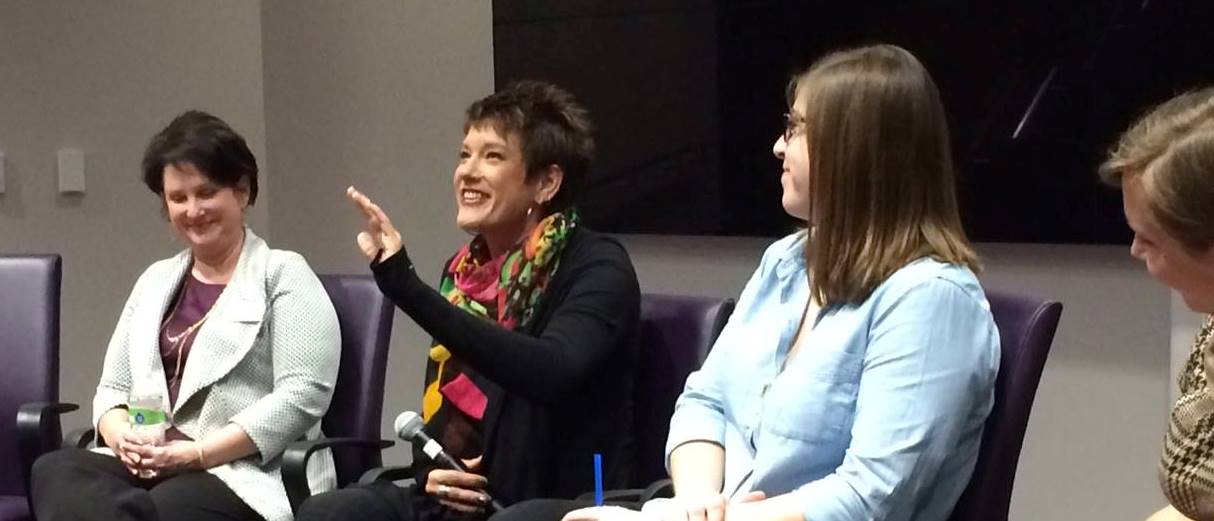
We were able to speak with several contemporary authors about their work. Lilace Guinard, author of When Everything Beyond the Walls Is Wild, critiques the ways normative gender constructs limit women’s access to ostensibly “public” places in the outdoors. In her memoir, Almost Somewhere: 28 Days on the John Muir Trail, Suzanne Roberts recounts the backpacking trip she and two women friends made the summer after college graduation, and how, hungry, wet, and often miserable, the three women find ways to feel that they belong in the outdoors as well as in their own lives. Both authors made time to chat about their work with the class, sharing their perspectives on how outdoor spaces both are and are not becoming more accessible to women and other marginalized groups. Caleb Roberts, a research scientist with the US Geological Survey, spoke to us about his dual background in science and creative writing.
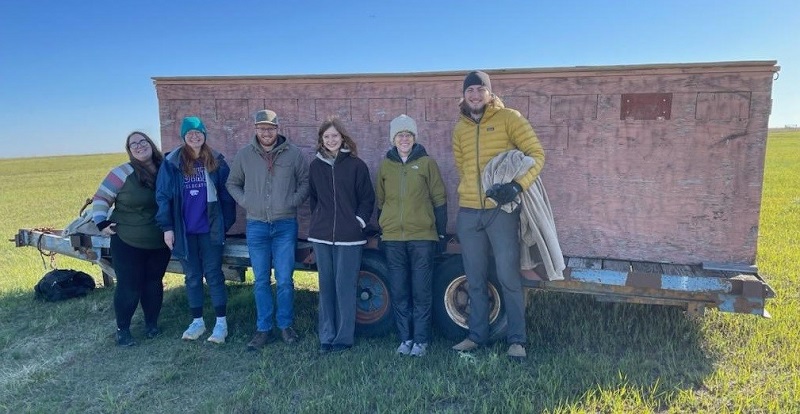
As the semester wound down, in April a group of five joined an optional field trip to watch prairie-chickens engaged in courtship display. Our location was a wooden blind—essentially a plywood box on a trailer into which the tallest of us could just barely fold himself onto a bench. Dr. Jackie Augustine, a doctoral alum from K-State’s Division of Biology and now the Executive Director of the Audubon of Kansas wildlife advocacy group, volunteered as our guide.

We did, indeed, see a handful of male prairie-chickens, dancing in the earliest slant-light of morning, and making the weird, rolling calls that sound like a cross between a two-note didgeridoo and someone blowing on a glass coke bottle. This is called booming, and it’s how a group of males show off to compete for a mate. One kept landing on the roof and making his rapid stamp-stamp-stamp-stamp-stamp above our heads, while others patrolled patches of prairie in front of the blind. They cackled, too, like demented cartoon witches.

Illustration of the Greater Prairie Chicken by Wild Lit student Palmer Bowles (BS ’24, Park Management and Conservation, Natural Resources and Environmental Sciences)
Back to the broad questions the course was designed to answer: What time did we have to get up to see the birds and then write about them?
One student drove in from Salina, so she’d been up since 3:45. But most of us got up between 5 and 5:30.
Next year we may consider camping along the Platte River in Nebraska to see the Sandhill Crane migration, so the drive would be a little longer, but we’d make the trip in daylight.
— Elizabeth Dodd, University Distinguished Professor
 K-State English