
AI IS THE DEATH OF MEDIOCRITY AND THE LIFEBLOOD OF EXCELLENCE
Imagine that I just cleared my throat. Those guttural sounds of clogged up mucus being shredded away, like that of a garbage disposal. Alright. Image completed? Then strap yourselves in and clench your toes: we’re talking about the dreaded topic of creative writing and artificial intelligence.

Poster for the film Dead Poets Society
Let me open with a quote, spoken by Robin Williams in the movie Dead Poets Society: “We don’t read and write poetry because it’s cute. We read and write poetry because we are members of the human race. And the human race is filled with passion. And medicine, law, business, engineering, these are noble pursuits and necessary to sustain life. But poetry, beauty, romance, love, these are what we stay alive for.”
While I will not be lending poetry much of my sweaty, grimy rope, the masterfully crafted quotation serves as the greater importance of all writing. If you would be so kind, I would like for you to keep it in mind as you read. It’s the crux with which all writing hinges, and the ultimate answer to any writer’s fear.
I’m not going to shy away from the dark reality that writers—novelists, poets, screenwriters, and everything in between—face today. When it comes to the terrifying being called in hushed whispers artificial intelligence, there’s a real reason to be deeply afraid. AI chatbots are capable of writing any story with a mere couple words. Not to mention the speed with which AI crafts; what it takes us feeble humans hours, days, weeks, sometimes even years to create, AI spawns in a matter of minutes. As if that isn’t enough, now anyone has the power to “write” competently, regardless of whether their minds are creatively limited to thinking making an apple blue instead of red is the greatest twist since Fight Club. I’ll go farther yet to audaciously claim that AI is just as good if not better than eighty percent of writers today. If that doesn’t put the fear of Death in your boots, let me just remind you of one more thing:
RIGHT NOW, AI IS THE WORST IT’S EVER GOING TO BE.
I apologize if I scared you with the above text, but I want this line to sit with you. If you think AI is good now at writing, just you wait another year, and you’ll be thinking it’s practically God. AI is constantly evolving, and humanity certainly isn’t going to do anything to stop it. It will continue to exponentially improve, and at some point, it very well might cause the mass genocide of the writing race.
Do not fear, however! The twinkle in your eye shouldn’t fade yet. Hope lives for writers who strive for greatness. Therein lies my overarching point, and presumably the reason why you clicked on an article such as this (or perhaps my name enticed you, I think wishfully). Any writer who is not surpassing an idealistic “good” should not look to publish. Now, I know this might be hard to hear if you are an inspiring novelist or if you have a dusty old short story you’ve been trying to get printed, but I’m going to be frank: AI can likely do just as good a job as you. If you want to survive in this harsh, bitter climate, you had better make sure you’re wrapped in many jackets. Don’t be like the lifeless corpses in my expository writing classes. In other words, you have to excel.
AI is the death of mediocrity, and perhaps even a step above that, but I will give it some credit for good: artificial intelligence will push writers to improve. Think of writers like Terry Pratchett, Stephen King, Neil Gaiman, R.F. Kaung, etc. These are the kinds of writers who produce a quality that can never be replicated (though I’m sure AI will try).
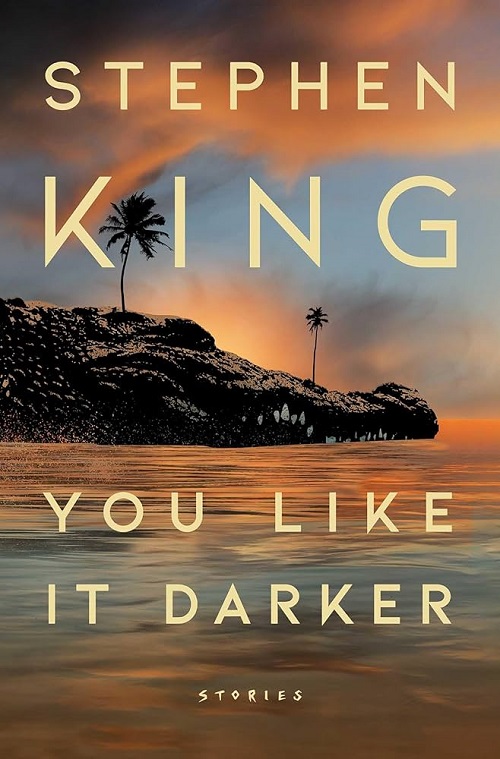
Stephen King’s most recent novel
If you want to be a writer today or tomorrow, then you have to strive for such greatness. You have to be a master of the words on the page. The fact is that if you’re not James Patterson, releasing banger after banger, but instead John Grisham, who should’ve stopped writing twenty years ago, then writing publicly isn’t for you.
I will make it clear here that I value writing as an exercise. I am never going to tell anyone to stop writing. I’m certainly not telling you to use AI to write your essays for school. There is a distinct value in writing that is irreplaceable. I simply think when it comes to sharing one’s writing with the greater world, we have to raise our expectations. If you write with cliches, you’re out (looking at you, romance novelists). If you write without passion, you’ve most definitely been taken out back and shot in the head. Don’t expect people to read something half-hearted or without purpose. My language might suggest you develop a writing ego—which is not a terrible idea—but I’m more so saying that a writer must strive, always, for better.
Maybe you’re unsure about your place as a writer. Maybe you’re not a writer, but you’re confused about the value of writers at all, if AI is so clearly potent and powerful. Don’t fret, wide-eyed fellows! I will assist you in recognizing the strengths that humans still have—in this current moment—over artificial intelligence.
There’s something about AI writing that just isn’t quite right yet. It’s good literally speaking—via grammar and sentence structure, I mean—but there’s no feeling behind it. Most stories by AI are well-written but lack energy; they’re as bland as saltines without the salt. Tiffany Yates Martin provides a perfect example when she compares her writing a story to an AI writing the same story. Humans can give writing vivacious life because we experience it constantly. Our credibility makes our writing feel more personal and passionate. AI, on the other hand, attempts to hit certain notes. It does not understand the why; it only knows that it is.
My point there is entirely unquantifiable, though, and honestly, also pretty irrational considering that AI will likely reach some level of emotionality soon enough. Originality, conversely, it is destined to fail at. AI must draw upon what already exists. To be fair, humans regularly do that too. We can’t help but work in or be inspired by our favorite authors’ styles, themes, and ideas. Yet even so, we have the capability to look at things differently. We possess the ability to have a human opinion, a vital factor Satyan Linus Devadoss points out in his article “A Math Problem for Pi Day.” To answer massive questions about topics like gender, race, and beauty, we must let the person in us speak.
AI can’t write what doesn’t already exist, nor can it layer what isn’t already understood. For instance, I’ve been thinking about my shower handle lately, and what it would be like if it was alive. That’s an idea AI would likely never come up with, but even if it did, could it give the shower handle the context I am capable of? I’m thinking the shower handle’s voice could be a character’s hallucination, representing a deeper fear of water. No, I’m thinking that the shower handle is representative of the way this character’s life weaves and twists around hot and cold. I’ll bring it even farther and say that the way you can only turn this magical shower handle in half a circle shows how the character always feels incomplete and only reaches halfway to their goals.
Weird, right? Did that convince you that would be a good story? Probably not. Is it original? Mostly, I think. What my shower handle example shows more than anything, though—and what I argue is the root of AI’s largest fault—is complexity. I have given meaning to an otherwise dull, ordinary subject. AI is not close to as capable as we are of layering their characters, settings, colors, objects, and, well, everything else.
Take a look at this terrifying picture. It’s AI generated art that I made with the prompt “weird fantasy creature.”
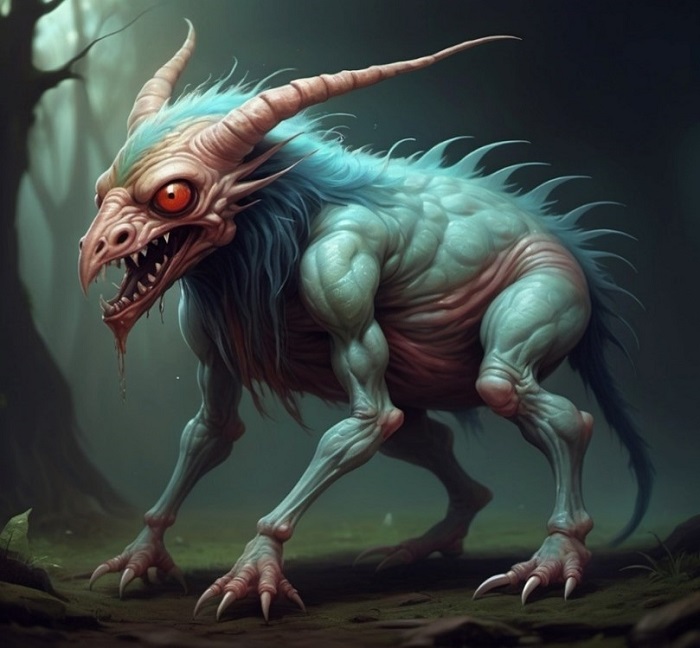
AI-generated “Weird Fantasy Creature”
Now, if AI were to come up with its own creature in a story, it might look something like this. Here’s the question: why? The AI doesn’t know. On the other hand, if I were to create my own creature, I would think about its every function deeply. In this AI example, I’d have a purpose for its horns, for the spiky fur, and even for its eyes being orange. AI creates without layered thought, something a good writer will always achieve.
Perhaps you are not yet convinced I have spoken any truth. Let me ask you this: who is your favorite author? Favorite musician? Director? If you had an answer to any of those—even if some random image popped into your head—you’ve just proved that there is meaning behind a creator. I know that I’d go see any Quentin Tarantino film no matter what he makes, simply because I love him as an architect of creativity. Of course, we put the quality of writing above all else, but we are also fans of people themselves. When you take away the human behind a work, you lose all passion, both from the audience and from the writer themselves. Many marketing schemes are great examples of this focus on individuals. Stress is often placed on the person behind the work, like with anything Ryan Reynolds stars in or Stephen King writes.
Writers indeed have AI beat in some ways, but writers are also undoubtedly losing ground. Many writers will be lost in the upcoming years to artificial intelligence. I’ll salute each as they join the ranks in their dirt-ridden graves. You might ask, then, am I afraid of AI? Well.
No.
I am confident in my writing. At the risk of how unhumble this will sound, I believe that my stories and my novels deserve to be published, read, and analyzed. I write with passion, complexity, and an intense, ever-present thought. All these things cannot be done by AI. I am at peace with that.
So where does that leave us, then? It’s a question without a real answer. I’d direct your attention back to the title, though. Creative writers, you can keep building and crafting and hope that you make it out there in the world. I’m all for that. I think everyone has the ability to write better than AI. To do so, however, you’re going to have to push yourself. Every single piece you write needs to be exemplary. You have to set a high standard for yourself. There’s no room for mediocrity. You must write something that is worth reading many times, over and over again till it forms a repetitious echo in your head. It’s not going to be easy, but we should never have strived for a middle-ground in the first place.
I will take the challenge. I will battle AI to my last breath. The only question left, then, is will you?
— Rylan Jackson (BA ’26)
 K-State English