
Today we share the fourth of six pieces of public writing selected for publication from an assignment in ENGL 801 “Graduate Studies in English” — and the first selection from Section A of ENGL 801, taught last fall by Cameron Leader-Picone: a piece of public scholarship (700-1,000 words) which tailors an academic paper and its scholarly intervention of 10-12 pages for a general-interest audience.
Read more about the assignment and the first publication, “Men, Monsters, and Maidens: Gender in Dracula” by Amber McAfee (MA ’26), in the post from December 5, and enjoy the subsequent posts: “Journaling on Mars: The Pen is Mightier Than the Planet” by Jeffery Jones (MA ’26) and “It’s Alive” by Juan Maldonado (MA ’26). Now, on to “Sarcasm at the End of the World” by Eve Wilson (MA ’25) —
— Karin Westman, Professor and Department Head / Instructor for ENGL 801 B/ZA (Fall 2024)
The most jarring thing about the end of the world is how nobody shows they care it’s coming.
Or if someone cares too much and makes a big deal about it in public, they’re dorks, they’re faking it for clout or money, they’re fools.
Or if they sincerely care, and they’re making an effort, it’s all for nought anyway. Nothing people do to mitigate the harmful effects of human-driven climate change matters, because nothing can stop it. The damage is severe and irreversible. The powers that be don’t want the world to be saved, so it never will be. Or whatever.
It’s cool to be publicly sarcastic about the end of the world, even if the speaker is privately concerned. Maybe that’s a defense mechanism. Maybe it’s a response to self-righteous screeds about Earth’s peril that place blame on individuals rather than institutions, then end with admittedly lame exhortations to reduce-reuse-recycle, or to solutions that rely upon everyone having a little more money (Saving the environment? In this economy?), or to the fine print on greenwashed products in Costco that make you wonder if anything will actually change before Florida becomes part of the Gulf of Mexico. Climate change feels like a catastrophe that is paradoxically both tangible and distant. It’s like a giant meteor hanging over the planet: it’s terrible, yeah, but while it’s still in the air, we have stuff to do. We’ll get back to thinking about that problem once we’ve paid off our student loans.
Because I’m not cool, I’m talking about the climate apocalypse, and to do so I’m pivoting to something I care about way too much: a video game about environmental damage and a Meteor at the end of the world.
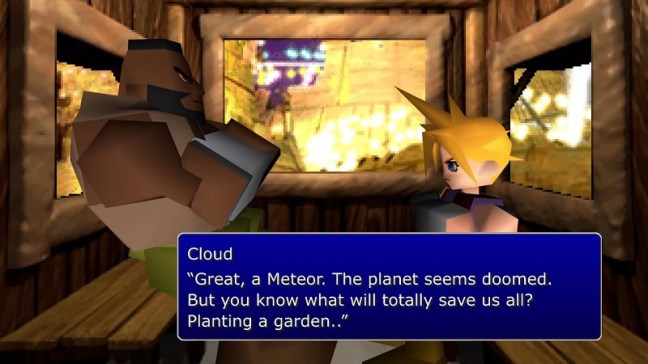
In 1997, during a decade that saw ecological concern become mainstream, developer Square (later Square-Enix) released the video game Final Fantasy VII. Cloud Strife, the buster sword-wielding protagonist, starts out the game with a reputation for being cold and sarcastic. He’s a hired blade working for a team called AVALANCHE to help facilitate an act of eco-terrorism: they’re bombing an energy reactor to stop the Shinra corporation from further harming the planet. As a result of the mission, people are going to die. The reactor is going to shut down and stop sapping the planet’s life force. But Cloud is there just for the paycheck, and most of his dialog choices for the first hours of the game let me, the gamer, make sure everyone onscreen hears it loud and clear: He is too cool to do anything but beeline toward solutions and ignore people’s feelings.
Cloud lives in the moment, using both his sarcasm and his everyday concerns to disassociate his attitude and actions from the possibility of expressing or feeling feelings toward the other characters in the game, the legacy of wrongdoing by Shinra, and the ensuing environmental/existential catastrophe facing the planet in the form of a magically summoned Meteor. Cloud’s coping strategies seem all too human and very relatable, and they give me pause when I consider my own efforts at environmental stewardship.
As much as I focus on the concerns of my everyday life, pivoting from considering how few recycled objects actually get recycled to what I should ask a gig economy worker to bring me for lunch, I inevitably think about pollution and waste when I see the meal at my door, a plastic bag holding a single-use fork and a foam container. That trash will probably make its way out to sea and slosh around in the Pacific Garbage Patch till kingdom come. Making jokes in the vein of environmental nihilism to myself and my friends is a familiar activity, if also overwhelming and defeatist when not tempered with effective solutions. The Meteor of climate change is still hanging over my head, as much as I try to avoid it. I and my fellow humans need to work to try to change policy and consumption habits to change collusion with systems of environmental exploitation. How can we make changes if, during the work of finding effective solutions, we tear down those whose ideas are not immediately effective?
In digital realms as well as in reality, all roads eventually lead to the end of the world. If we are fortunate enough to be able to reflect on our time, we are forced to grapple with and come to peace with how we feel about the end – and sometimes about our culpability in that ending. Final Fantasy VII had a weird and divisive finale. After 70-plus hours of gameplay, after the big boss battle, after the planet dealt with Meteor, a title card reading “500 years later” showed me something I didn’t expect. One of the playable characters was a long-lived talking coyote; he and his cubs approached a silent, overgrown city, the fallen technological capital of the world that was, and the game’s title card appeared, fading to black to the sound of youthful laughter.
The story ended on what I thought was a bold note, one I found satisfying for two reasons: one, it confirmed my fears about the future of humanity, which was validating in an age where climate change was (and is) so politically divisive; and two, it let me imagine a future without humans, which I still think is an interesting rhetorical move for a traditionally-unserious textual medium.
At the time I finished the game, all I thought was, “Well, that’s it for the humans. We had it coming.”
In the ensuing decades since the game’s release, I’ve joined the divided discourse around the ending. Were the cubs laughing, or were there offscreen human children? (The developers said the latter when they announced a sequel in 2003.) Why weren’t signs of human life shown onscreen? With no one to debate this game with other than my brother, I let the no-humans interpretation shape my personal understanding of and peace with the end.
The ludic power of video games allows players like me to imagine the world after the end. It also allows us to imagine a fictional lower-stakes apocalypse that explicitly allegorizes what’s happening on Earth, to use a fantasy world for creative thinking about real-world problems.
The problem with creative thinking and opening your mouth is gaining critics. But that’s not always bad. The begrudgingly moderated comments section of many online eco-activism articles can bear fruit even from mockery. Useful, thoughtful, and kind responses can be balanced out with responses that, while often sarcastic, nonetheless show some utility, some thought, and some kindness. It is arguably useful and kind to respond to blind optimism and fruitless efforts with a reality check.
Sarcasm is also arguably better than nihilism. While sarcastic responses offer biting criticism and arguably a measure of disappointment, they implicitly suggest there’s better action to take: a solution can be found. Sarcasm is an expression of pain, but it’s also an expression of hope. Hope in the face of the apocalypse, no matter what quarter it comes from, is the thing that will keep us trying to find effective solutions to problems that threaten the world we care about.
Works Cited
Final Fantasy VII. PlayStation, Square, 1997.
Kaizzo, Final Fantasy VII UI. Codepen.io, n.d. https://codepen.io/Kaizzo/pen/aGWwMM
— Eve Wilson (MA ’25)
 K-State English
3 thoughts on “Sarcasm at the End of the World”