
Today we share the fourth of six pieces of public writing selected for publication from an assignment in ENGL 801 “Graduate Studies in English” — and the first selection from Section A of ENGL 801, taught last fall by Cameron Leader-Picone: a piece of public scholarship (700-1,000 words) which tailors an academic paper and its scholarly intervention of 10-12 pages for a general-interest audience.
Read more about the assignment and the first publication, “Who is Writing?” by Mizanul Bari (MA ’27), in the post from December 11, and enjoy the subsequent posts: “Localization: Some Local Nonpharmaceutical Interventions During the COVID-19 Pandemic in Ghana” by Daniel Effah (MA ’27) and “Why You Should Read the Comments of Paris Paloma’s ‘Labour’: Everyday Work, Capitalism, and Unrecognized Emotional Labor” by Ruth Okon (MA ’27). Now, on to “Anxiety and Aesthetics: The Frutiger Aero Aesthetic” by Sydney Kelso (MA ’27) —
— Karin Westman, Professor and Department Head / Instructor for ENGL 801 B/ZA (Fall 2025)
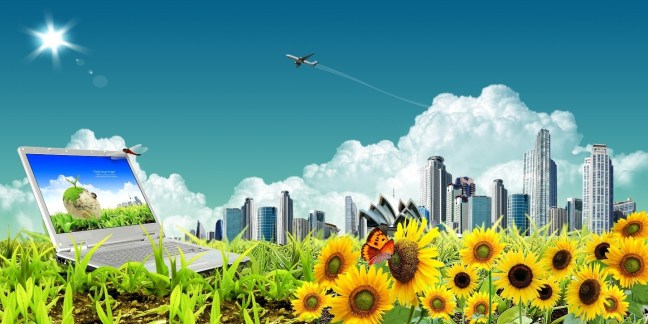
The year is 2007 and you’re 8 years old. You’ve finished your homework for the day and it’s raining outside, so your parents let you log on to the family computer to play a bit of the hit new Windows game, Purble Place. On the home screen is an image not unlike the one pictured above. You do not know it, but while the picture is pretty to look at, it is also sending a message, and you are not the target audience. Instead, the target audience is your parents.
The early 2000s were filled with technological evolution and anxiety surrounding technology; fears ranged from uncertainty about technology changing the job market to the event of Y2K itself (Powell 2369). This anxiety was likely not at the forefront of your mind when you were 8 years old. Along with the Windows video game Purble Place came arguably more groundbreaking things, like YouTube (2005) and the first iPhone (2007). Tech was becoming increasingly unavoidable, both in professional and personal lives, but there was also a lot of anxiety around it. In the midst of all this anxiety came the aesthetic that dominated computer wallpapers for years: Frutiger Aero.
Frutiger Aero is an aesthetic that covers a wide range of cultural products, from to music to real, tangible objects like Softsoap’s Aquarium Series soap dispensers. Perhaps the most recognizable Frutiger Aero artifact is the wide array of computer wallpapers that dominated computer screens in the early 2000s. Typically featuring a blend of an idealized nature and a utopian cityscape, Frutiger Aero pushes an idea of calmness and harmony to viewers (Avci 462).
The aesthetic consists of bright colors that contrast warm natural colors with cooler metallic ones. As pictured above, for example, the bottom right corner prominently displays a field of sunflowers. An orange butterfly visits the flowers, while a red dragonfly visits the computer, which sits in the grass and also displays grass and an earthy globe on its screen. In the background is a version of Sydney, Australia’s cityscape and a plane leaving the city. The sun shines brightly on this beautiful day.
Of course, this landscape is not how the outside of cities typically looks. The outside of cities are often riddled with highways going in and out of different sections of the city. In the ideal world of Frutiger Aero, though, you can quickly get from the countryside to the city to work, and once your work is done for the day, instead of returning to a one-bedroom apartment in that same city, you can easily return to the fields, where the butterflies and flowers will greet you as you seek rest in the soft grass. Just as there are no one-bedroom apartments, there are also no houses in the fields of the Frutiger Aero landscape. Instead, you are at complete harmony with nature, living amongst it, yet leaving it daily to work in the city.
This portrayal of a fictionalized relationship between nature and the city sends a sort of subliminal message to viewers of Frutiger Aero wallpapers. When they boot up the computer in the morning, after clocking in and refilling their cup of coffee, they are greeted with blue skies and flowers, a sight which initiates both a calming effect and a stimulating effect. The ambience of the natural photos evokes the calming effect, and the bright blues, greens, and yellows evoke a stimulating effect, ideally simultaneously calming the viewer and waking them up (Al-Aysha et al. 197). This scene gets employees in a tranquil, yet productive mindset, ensuring that they will get as much work as possible done while causing as few problems and facing as little anxiety as possible.
The idea of subliminal messaging in these images is not entirely bad; bringing calmness and productivity to Monday morning is certainly a noble goal of a wallpaper. It must be noted, however, that these images do not reflect reality. As was briefly mentioned, cities need roads leading into and out of them. Frutiger Aero images, while prominently highlighting nature at the forefront of the pictures, highlight an unrealistic idea of nature. The skies are always blue, the butterflies are always landing on the most vibrant flowers, and the city is distant, yet still close enough to see in some detail. No pollution has leaked into the neighboring flower fields. The images are idealistic, not realistic.
Their idealism helps drive home these calming, yet stimulating, effects, though, so while they aren’t realistic, maybe they don’t have to be. Frutiger Aero images show an ideal world, an ideal future to work towards. While it has been just about 20 years since the peak of Frutiger Aero wallpapers (with the first wallpapers debuting in 2004), the images depicted are still something that can be worked towards (“The Frutiger Aero Archive”). Cities that don’t pollute the nearby fields, which only produce the healthiest flowers to feed pollinators, seem like something wonderful to work towards, and while we aren’t there yet, maybe with a little of Frutiger Aero’s optimism, we’ll get there one day.
Works Cited
Al-Ayash, Aseel, et al. “The Influence of Color on Student Emotion, Heart Rate, and Performance in Learning Environments.” Color Research and Application, Vol. 41, No. 2, 2016, pp. 196–205, https://doi.org/10.1002/col.21949. Accessed 26 October 2025.
Avci, Emirhan. “Physical Reflections of Digital Aesthetics: The Influence of Frutiger Aero on Interior Design.” E-Journal of New Media, Vol. 8, No. 3, 2017, pp. 456–82, https://doi.org/10.17932/IAU.EJNM.25480200.2024/ejnm_v8i3003. Accessed 22 October 2025.
Powell, Anne L. “Computer Anxiety: Comparison of Research from the 1990s and 2000s.” Computers in Human Behavior, vol. 29, no. 6, 2013, pp. 2337–81, https://doi.org/10.1016/j.chb.2013.05.012. Accessed 28 October 2025. “The Frutiger Aero Archive.” Frutiger Aero Archive, https://frutigeraeroarchive.org/. Accessed 16 October 2025.
— Sydney Kelso (MA ’27)
 K-State English