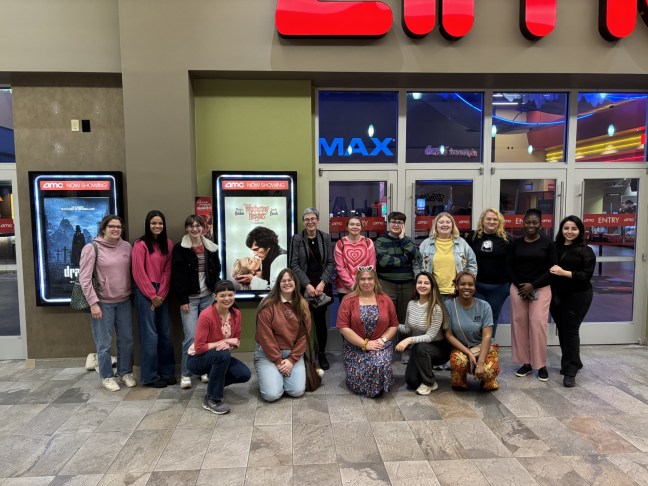
English Department faculty and students attend opening night of “Wuthering Heights” (13 Feb 2026)
On February 13, a group of intrepid undergraduates, graduate students, and faculty from K-State’s Department of English ventured out to the local cinema to watch one of this year’s most talked about literary adaptations, Emerald Fennell’s “Wuthering Heights” (2026).
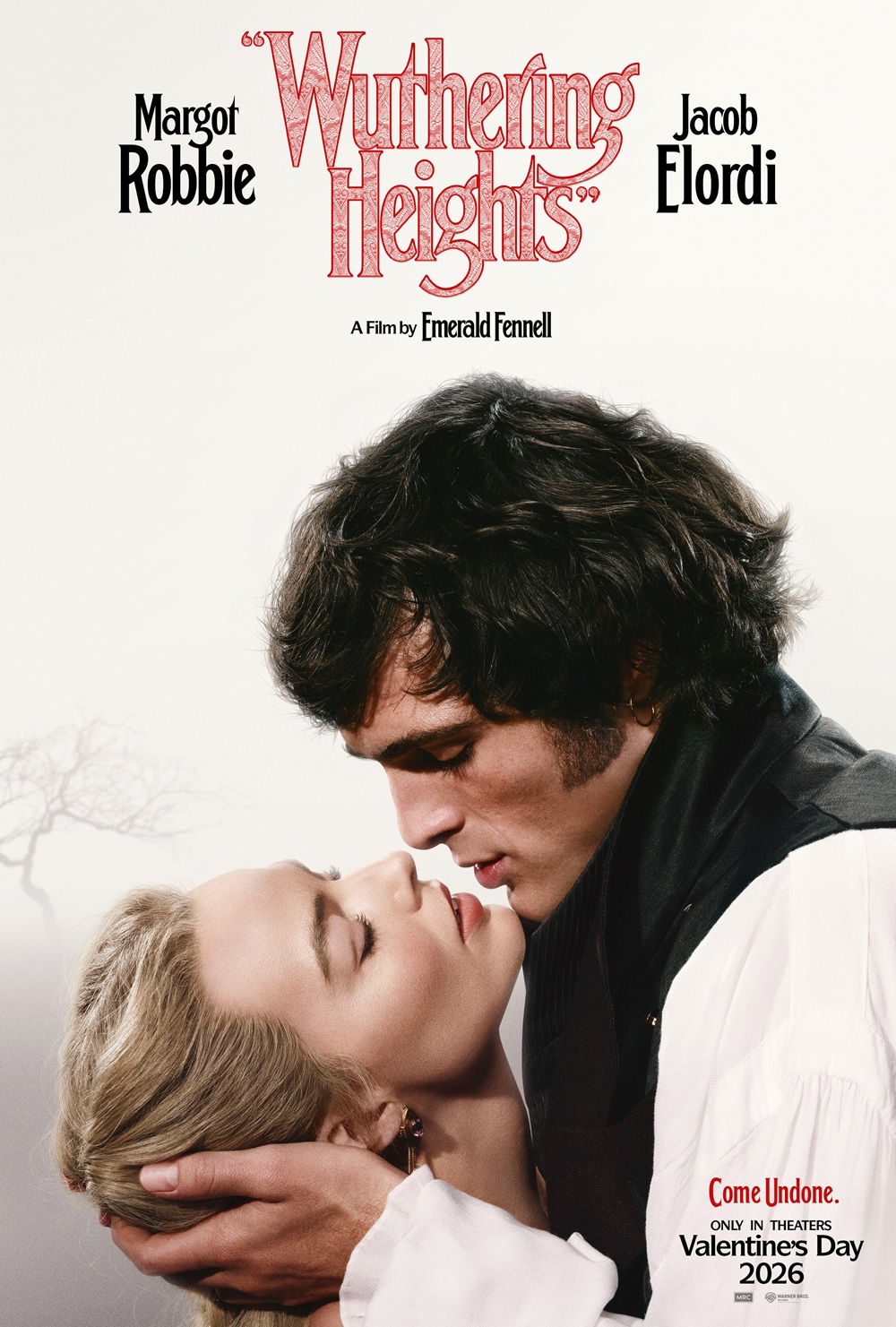
Settling in with our popcorn and soda, we chatted about the controversies circulating online: the decision to cast Jacob Elordi as Heathcliff, a character repeatedly racially Othered in Brontë’s novel; the choice of Margot Robbie, an actor around twenty years older than Cathy Earnshaw; the inclusion of historically inaccurate costumes and — perhaps most egregious of all — wallpaper that reproduces close-ups of Robbie’s skin on a giant scale…
As lights began to dim, we experienced — with some apprehension — what Nicole Kidman likes to call “that indescribable feeling when … we go somewhere we’ve never been before,” in this case, Fennell’s highly personal vision of Brontë’s novel (yes, those quotations marks in the title are doing a lot of work).
For some of us (well, okay, me), Fennell’s idiosyncratic imagining veered too far from our own “Wuthering Heights,” in an adaptation that amped up the sex and romance but somehow lost the weird power of Cathy and Heathcliff’s relationship in the process. For others, perhaps less emotionally deadened than I am, Fennell’s visually charged adaptation exceeded expectations, provoking gasps, laughter—and even a few tears, furtively wiped away as the lights came up.
But rather than hear these responses secondhand, let me honor the frame narrative that Fennell ignores by turning this blog over to some of our student viewers…
— Anne Longmuir, Professor
What Makes a Good Adaptation?
As far as I can tell, the divide of what makes a good adaption is between (1) how faithful to the original material is the adaptation, and (2) how does the adaption change the original text in a way that is creatively transformative or allowing a new audience to understand the text in a more modern context. Very likely, my peers and the faculty members discussing this in the blog will divide along these lines in whether they enjoyed the experience of seeing “Wuthering Heights” in theaters.
As a creative writer myself, I can understand the second option. What does it mean to explore the aspects of a text and then make it your own? How do you take something written for a particular time and audience and transform certain messages or themes for a modern audience with different values? After watching the movie myself, I think this is the direction Emerald Fennell was going with, especially adding in her own strange, if at times questionable, touches (which emulates the same vibes of her film Saltburn). However, often the argument against this is: why not just make your own original content exploring these themes? And to that, well, unfortunately we do live in a capitalist society where a known IP is more valuable than an unknown one. Why else are we seeing an influx of adaptations, sequels, and remakes in the box office these days?
Will I watch Fennell’s adaptation again…probably not, unless I need to use her as an example in paper about adaptations. Ultimately, I do think the film is filled with fascinating creative choices, but not enough for me to rave about in relation to the text itself and its important themes. Though I do question how much it is supposed to be seen as an adaptation since the movie is titled with quotations, but that might need a longer conversation.
One benefit I do wish to highlight about this adaptation coming out is this: everyone is talking about Wuthering Heights. Before, I rarely heard about the book outside of the English Department, but now it is everywhere. I also find, when people know it is an adaptation, they will read the original work, so at least we can take solace in knowing a beloved book is popular once more and Bronte’s work is in the current limelight.
— Caitlyn Crane (MA ’27)
Questions about Adaptations
Wuthering Heights is a book that has been on my “TBR list” (to-be-read list) for a while now, and after seeing the new “Wuthering Heights” movie it has definitely jumped to the top of the list, but not because the movie was phenomenal—it’s quite the opposite, actually. While sitting through the movie, I kept glancing over to my peers who had read the book, checking to see if they were making the same bewildered faces as I was. They were.
From the conversations I heard going on between people who had read the book, it seemed to me that the new adaptation had taken a lot of creative liberties. It was also pointed out that the movie ended only halfway through the book, failing to show the next generation. This has made me think about adaptations as a whole and how closely they should follow the source material. In my opinion, movie adaptations of books should follow the source material at least somewhat closely, keeping the overall story and major plot points the same. This is something that “Wuthering Height” did not do. Emerald Fennell, the director of the film, explained the movie as being “her 14-year-old self’s interpretation of the book,” which already made it distant from the original source (Jessop). This is also why the title is in quotations—it is an interpretation of the novel, not mean to actually be Wuthering Heights. On top of that, Jacob Elordi was cast as Heathcliff, taking away the racial aspect of the story, and, as previously mentioned, the story was cut in half. Finally, there were all the sexual scenes, from mildly suggestive shots to blatant sex scenes; there were so many that sex between Heathcliff and Catherine Earnshaw became the focal point of the piece.
The disconnect between the source material and the movie makes me wonder why Emerald Fennell chose Wuthering Heights as a medium to tell this steamy story, rather than simply using the setting as inspiration for her own period piece, especially when other adaptations that took on a different name have been successful (Clueless, for example, which is an adaptation of Emma). While I don’t have an answer, the new “Wuthering Heights” certainly brings up questions of how adaptations and inspiration function in the modern day.
“Do you want me to stop?” Jacob Elordi, cosplaying a white-washed Heathcliff, whispers. “Yes,” I think, “yes, please stop.” “No,” Isabella Linton whispers. My lungs tighten and I look down at my knees as yet another sex scene unravels. How many has it been now? I look over to Sydney, her eyes closed once more, eyebrows strained from a scowl of disgust that seems permanent now. I’m bewildered. I feel the urge to lean next to Taylor on my right, to ask her the question I have been asking every ten minutes since the movie began: “Did this really happen in the book?” Each time, Taylor shakes her head, eyes bulged and baffled, as she mouths a “no.”
I’ve been in this theater for an eternity now. I think I missed my graduation. I think I may have even missed my Ph.D. My brain is numb, confused, confounded — how many synonyms can I barf on the page before I accurately convey the sheer terror this movie set in me? Perhaps terror isn’t the right word — I am unsure of what the right could even be, at this point.
I should have known things weren’t going to be good the moment the movie opened with a man moaning. I exchanged a glance with Sydney — “what kind of bullshit did we sign up for?”— and look back at the screen just in time to see that it’s a man hanging. “Oh, thank god, that’s much better,” Sydney sighs, and Taylor can’t help but let out a confused laugh. A thought crossed my mind — “maybe this won’t be as raunchy as I heard it was…”— and as though the film read my mind, a close-up on the dead man’s boner popped into view. Nevermind.
Halfway through the movie I whisper to Sydney how much longer we have — it’s a cry for help — and Sydney seems brokenhearted to shrug her “I don’t know.” We both feel as though we are in Hell.
I leave the theater feeling like a soldier stepping foot outside of the trenches for the first time in years. I’m shell-shocked. What was it that I just witnessed? I consider the fanfiction I read back in middle school on a dare — the kind I shouldn’t have been — and realize that even that had better narrative structure, better justification for it’s smuttiness, than Emerald Fennel’s poor excuse of a self-insert fanfic.
— Aidia Kite (BA ’24, MA ’27)
“Wuthering Heights” has got to be one of the worst adaptations ever, and everyone seems to be in agreement. Not only did they change one of the main characters of color to be played by a white man, they also just left out so many pivotal characters from the novel.
However, I feel bad that everything is judged by that. So let’s talk about what went wrong aside from the adaptation. The plot, as followed by Cathrine Earnshaw, left the audience wishing for death. The “will they won’t they” of Catherine and Heathcliff involved the other characters and the audience into a toxic relationship we want no part in. Unlike Isabella, we are trapped by a leash (the money spent) in the theater to watch the horror unfollowed before our eyes – knowing this is going to end in tragedy for everyone: Catherine, Heathcliff, Isabella, Edgar, Nelly, Us (the audience). Catherine dies, Heathcliff loses his situationship, Nelly sees the friend she tried so hard to protect fall into ruin and die, and Edgar and Isabella are just there.
Maybe things could have been forgiven if the actors had this brilliant, out of this world chemistry. Spoiler alert: there’s no chemistry. It feels like the actors are contractually obligated to be there, which they are but we don’t want to know that. Margot Robbie and Jacob Elordi are brilliant actors, but not suited for this weird hodgepodge of Euphoria meets old British aesthetic.
The character I ended up holding the most sympathy for was actually Nelly. That girl was loyal to her friend that ditched her for a man (happens to the best of us Nelly) and followed her morals at the same time. The girl needed a new job and a new bestie.
All in all, see “Wuthering Heights” with a group of your closest friends if you want to have a good time. A good time laughing ~at~ the movie that is, not with the movie.
— Kori Travis (MA ’27)
I am a passionate fan of the Gregory Maguire Wicked books. When I reflect on my experience watching Wuthering Heights, I am strongly reminded of my experience with both the musical and the films of Wicked, watching them after having studied the novel. The creators of the musical/film Wicked took the setting, the characters, and the basic premise, then made plot adjustments to better fit a theatrical/cinematic experience. This is what they did with Wuthering Heights. The two estates are present as are the same characters. I feel the first half of the film is relatively true to the book (with some exceptions such as the bit with the eggs under the bedcovers), then as the creators sought to wrap up the cinematic plot, they made dramatic changes.
My take on the character Heathcliff, in reading the novel, is that he is despicable. In ENGL 310, we got into discussion about genre, what is the genre of this novel. I stated that it feels to me like a melodrama. Heathcliff is decidedly a villain. The film portrays him as sympathetic and alluringly likeable; he is played by a stunningly beautiful actor, and his presentation in general is endearing.
When I read Wuthering Heights, I got a sense as to why a woman’s time giving birth to a child is called her “confinement.” For a particular class of people, and during a specific period, women were expected to hide when it is time to deliver a child. Both Catherine and Isabella, in the book, give birth as kind of a surprise. It seems as if they are notably sick, then all of a sudden, we have a new character in the story, a character whom they birthed. I wonder if they are planning a sequel to this film, perhaps depicting the novel’s second volume. I am afraid I might be giving away one of the film’s “endings,” but when Catherine dies in the film, we see an image of her, lifeless, in bed, and bleeding profusely. The bleeding is clearly centered from her groin. Did this character just bring a new life into the world, Catherine, Jr.? To be continued?
— David M. Ollington (BA ’26) / Academic Advisor, Department of Sociology, Anthropology, and Social Work
Red, Cinema, and the Missing Ghosts: My First Encounter with Wuthering Heights
For some reason, I have never read Wuthering Heights, even though I have come across the book several times and have had the chance to actually read it. I had it in my school library, but I never got around to reading it. However, I had the chance to see the film adaptation on the eve of Valentine’s Day, and I must say that, based on the conversations I have engaged in about the book, it was kind of different from what I expected. I know that the book itself had some Gothic elements, and I expected that to play out in the film. However, there was no element of goth or ghosts, so that was a bit of a disappointment for me. I’m a fan of horror, and I was hoping to see some horror in the film. That’s why I went. I also went because I was interested in seeing a film adaptation of a book that is so popular but that I have never read.
One thing I loved so much about the film, apart from the costumes that were used, was the filming. The filming was great, especially the use of colors. I think Caitlyn said that one could write a whole paper about the effects of the videography, and I totally agree.
The use of red in certain frames, objects, costumes, and as a background color, was really catchy, and I kept thinking about what the purpose of that color was. One scene that really stood out to me was when Heathcliff was approaching the deathbed of Cathy and the background lights were all red. In the way the shot was framed, it seemed as though he was going to come out of the screen and right into the auditorium. That was a fantastic filming moment in the film!
Overall, it was great watching the movie with faculty members and other students who I’m sure had read the book. It was also great talking to people who have read the book and asking them what their experience of the adaptation was. Like me, some of them were more impressed by the filming than the plot.
— Ruth Okon (MA ’27)
Evoking Claire McCarthy’s Ophelia (2018), an adaptation of Shakespeare’s Hamlet, Emerald Fennell’s “Wuthering Heights” rides outside of its source parameters and settles between the lines. In Emily Brontë’s novel, Nelly recollects events from years past. Just as we barely see Ophelia’s madness until her death, readers never hear of Cathy’s story from her own mouth or hand, but from a narrator who coaxes readers into a certain perception of the young girl. Fennell’s film focuses on moments where Nelly was not present and therefore could not describe to Mr. Lockwood. In doing this, Fennell freed Cathy and Heathcliff’s relationship from the boundaries of a single narrator allowing it to blossom on the screen for what it was.
Fennell, attuned to threading Shakespearean literature as shown in her film adaptation of A Midsummer Night’s Dream in Saltburn (2023), recognizes Wuthering Heights for what it is: a tragedy. When Cathy first witnesses Isabella and Edgar in the movie, Isabella dramatically retells the plot of Romeo and Juliet to Edgar. Juliet dies, Romeo commits suicide, Juliet then revives, discovers her love to be dead, and commits her final act of suicide. As Heathcliff proclaims that he cannot live without his soul over Cathy’s dead body, previous readers of the novel are aware of Cathy’s return yet to come to Wuthering Heights. I wondered if Fennell would bring Romeo and Juliet’s ending to a literal outcome onto the screen, but as the credits rolled, I realized that Cathy’s ghost does revive and finds her lover a shell of a man eternally damning them both until Heathcliff joins her in death. Fennell directs “Wuthering Heights” final moments to Emily Brontë’s story as an echo of Romeo and Juliet indeed.
My Instagram feed is newly flooded with “Which 19th-century female lead are you?” and countless opinions. Many critics cannot look beyond the overt sexual nature of the film, but I invite you to please do and discover the rich layers of symbolism that I have not even begun to brief upon in this short review. Whether you hated or appreciated the movie, Emerald Fennell has not only raised Cathy’s spirit in her most recent film, but also a revival for 19th-century English literature and the Shakespearean tragedy. We shall see a new wave of classics and a return to period genre in contemporary literature in 2026 that may well live past this year.
— Madi N. Love (BFA ’26, Studio Art / English Minor / Film Studies Certificate)

 K-State English