
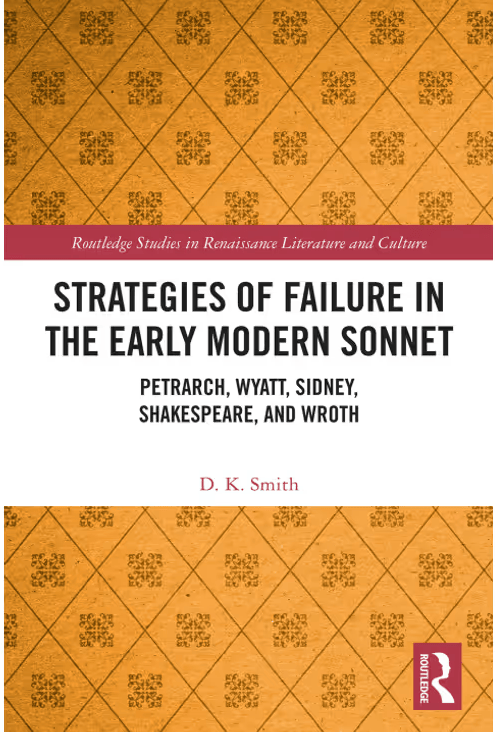
Too many years ago I was speaking to a colleague about a book I was thinking about beginning. I was a little shy about it, since it was in its early stages, but we always turn to our colleagues for support. So I said, “I’m interested in the idea of failure in the Petrarchan sonnet sequence. I think it could be interesting and new.” And this colleague, whom for the purposes of this blog I’ll call “Dave Smit,” said, “That’s not new. Everyone knows that.” Now, “Dave Smit” is a very smart guy, so of course my first response was, “Well, I can always become a plumber.”
But here’s the thing. As time passed, the idea still seemed new to me. So I decided I’d give it a try. Besides, one benefit of redefining the nature of failure in the western literary canon is that it means the terms of success are pretty much open to interpretation.
Failure has been a part of western poetry at least since the eleventh and twelfth centuries when a host of troubadour poets started singing about the pleasures and pains of not getting the girl. They wrote about reverence, desire, loss, frustration, suffering, and spiritual longing. They wrote, in short, of almost every topic that would later thread its way through the western love lyric. And they established a varied approach. Sometimes you won your beloved; sometimes you didn’t. Love wasn’t easy, but at least it was possible.
But then, in the fourteenth century, when Francesco Petrarch began to draw together all these ideas into what would become one of the originary moments of Renaissance poetry, he effectively launched himself and his literary successors on a brand new course. For Petrarch, writing beneath the heavy weight of St. Augustine and Christian doctrine, whatever else love might be, it had to be unrequited. Under his influence, the lyric tradition became one that, if it didn’t precisely reward failure, certainly required it. Before Petrarch, the failure of love was a choice, a danger, a threat, a disappointment; after Petrarch it was merely essential.
But while almost everyone has noted the existence of failure in the Petrarchan enterprise (pace Dave Smit), no one has given it its proper due. Readers have tended to see it as a necessary side-effect of Christian spirituality or simply as a familiar poetic trope— an all but inadvertent aspect of the genre. But I’d like to consider the way that failure, from the time of Petrarch, has been self-consciously harnessed. For in making the failure of love essential, he introduced a variety of other sorts of failure as well. And in so doing he introduced into the Renaissance lyric the means for representing a new and expanding expression of psychological complexity.
In the long history of Renaissance subjectivity, the awareness of what it means to be a thinking, feeling individual has drawn on a variety of sources. In the last fifty years, scholars have turned to Freudian psychology, Marxist economics, religious developments, new notions of privacy, new forms of dramatic self-representation, projections from the present day, and “self- fashioning” in all its wider cultural negotiations. Some critics have seen the existence of subjectivity in sixteenth-century England as a largely modern invention, while others have looked all the way back to Petrarch’s Canzoniere and the fourteenth century as the new beginning of psychological complexity in Western literature. But in each of the varied approaches there has been a fundamental sense that this burgeoning representation of self-awareness is founded on some new form of perception, some new marker of complexity and success. In this book, I examine how it might be more directly tied to failure.
But why failure? Why should this be a useful or interesting means to gain entrance to these poems?
There are a number of things failure can do that success cannot. And there are expectations that can best be examined by showing how they do not quite come true. Success confirms us in our view of the world. When we find what we expect— in a poem, a story, or in life— we simply accept it as our due. Success confirms us in our beliefs and reassures us about our ways of thinking. And in doing so, it curtails the impulse to develop. We remain what we have always been, and the shape of the imagined world remains unchanged.
But failure discommodes the settled sense of things. It requires a new and expanded way of understanding. Instead of simplifying and confirming, failure forces the speaking subject—the poet or the reader or the narrative voice of a poem—to face the limits of what is known and to create something new in its stead. In adapting to this changing shape of the world, the mind turns back on itself, highlighting the process of its own thoughts. To represent a character dealing with failure is to throw into high relief the complex ways a mind can think about itself. In this light, the limits and pressures of failure— the way it constrains and channels and shapes a poetic subject’s responses to her own thoughts and expectations— can be seen as one of the formative influences on the Renaissance lyric.
Looking at one of the earliest Western sites of developing subjectivity— the Renaissance sonnet sequence— I consider how the increasingly complex and self- reflexive representation of the thinking, feeling subject has been tied, in ways that have gone largely unnoticed, to the recurring strategy of falling short. Examining the work of a wide variety of early modern English poets, from Thomas Wyatt to William Shakespeare to Lady Mary Wroth, I explore the way a deliberate strategy of poetic and personal failure develops over the course of the 16th and early 17th centuries to create a new means of representing the complexity of the literary mind at work.
Though exactly how I do that is, as Rudyard Kipling says, another story.
I’d like to end with another conversation with another anonymous colleague. I had just arrived at K-State, and we were talking about an article I had recently published. He was perfectly charming and decidedly erudite, and he said, “It’s quite well written. But I don’t believe a word of it.” Well, Michael. I don’t suppose you’ll believe a word of this one, either. But I hope at least you’ll think it’s quite well written.
— D. Kimball Smith, Associate Professor

