
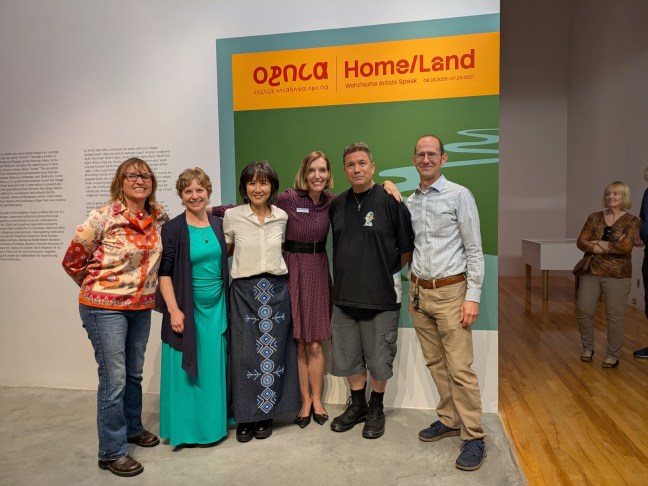
Last Monday, October 12 marked the 11th annual Indigenous Peoples Day at K-State.
It was a special collaboration, co-organized by the university’s Indigenous Faculty and Staff Alliance and the staff at Marianna Kitsler Beach Museum of Art.
The event featured online keynotes and breakouts as well as an in-person visit to the Beach’s new exhibition of Osage works, “Home/Land: Wahzhazhe Artists Speak,” curated by Aileen Wang.
The day’s theme, inspired by the Beach Museum exhibit, was “Home/Land: Art, Culture & Place-Making.” The program featured three prominent Osage artists as keynote speakers, two of whom, Anita Fields and Norman Akers, have pieces in the exhibit. Breakout sessions centered on art and culture, including talks from artivists (musician-activists), multidisciplinary artists, and experts in Indigenous languages and cultural revitalization.
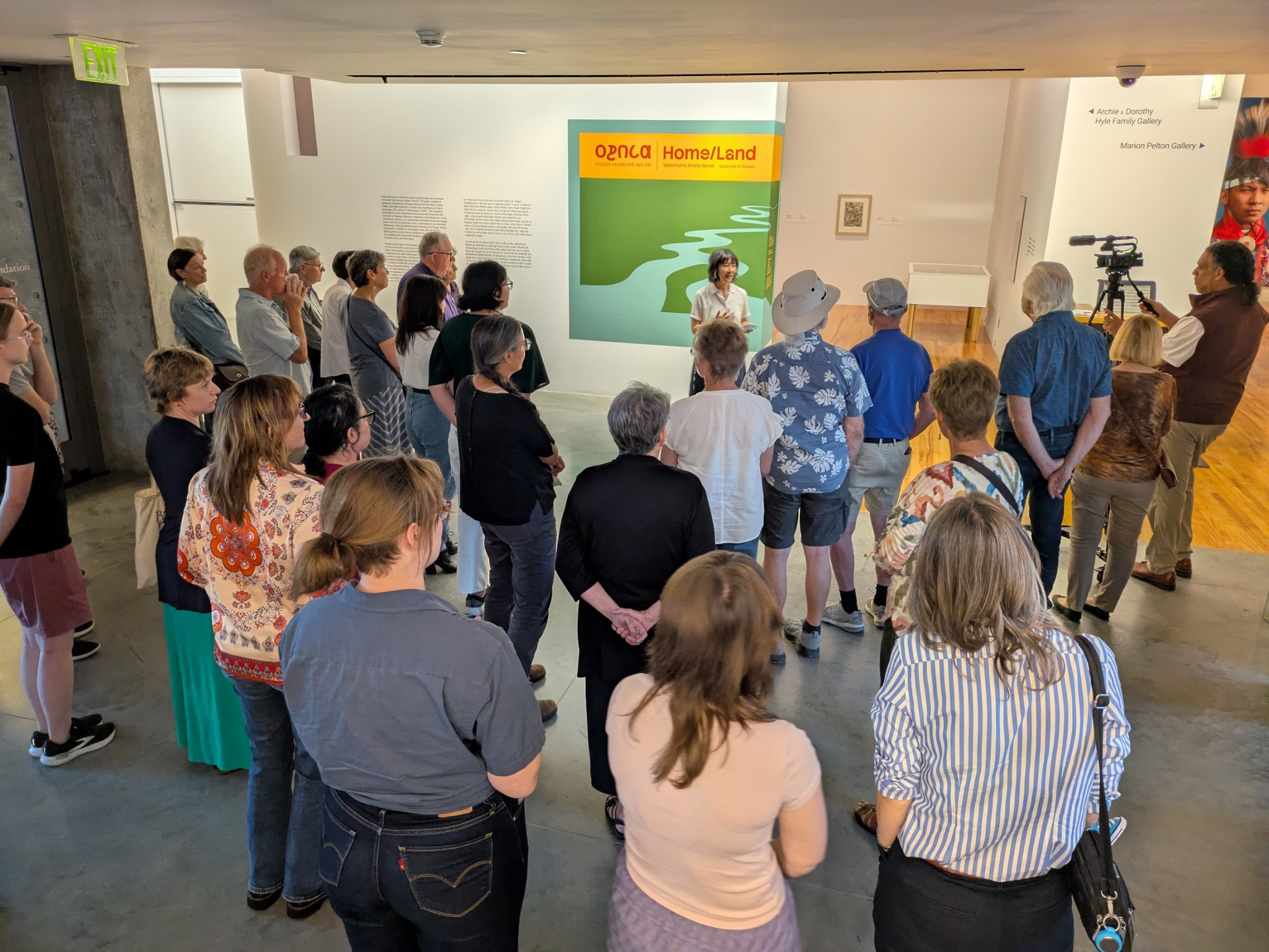
Aileen Wang hosts a gallery tour of “Home/Land: Wahzhazhe Artists Speak” on Indigenous Peoples Day. (Photo by Liz Seaton)
Artist Anita Fields (Wahzhazhe/Osage and Muscogee) was the first to discuss her signature work and process with those gathered online. Fields’s art combines clay and textiles with Osage knowledge systems to explore cultural influences at the intersections of balance and chaos. Through this work, Fields questions how Indigenous histories have been distorted or erased. Fields’s textured visuals encourage viewers to explore ways of understanding history beyond settler colonial narratives, positioning Osage knowledge and cultural practice as the lenses through which the nation’s history might be wholly understood. Anita’s piece below draws parallels between Indigenous people and the elk as beings settler hunters use for target practice. It is made of several pieces of foam and there is a cutout section on the elk’s side with a spray-painted target.
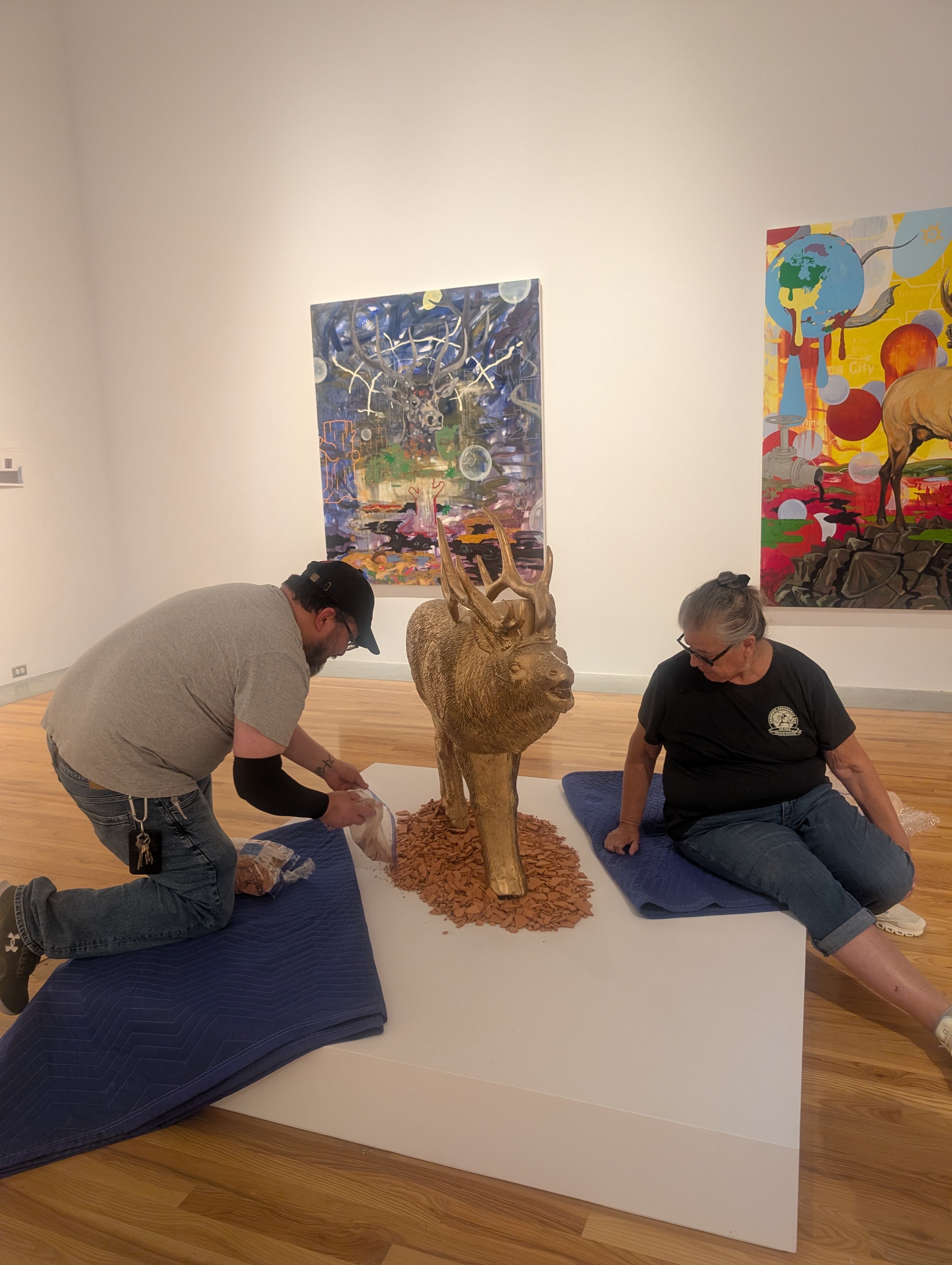
Anita Fields and Luke Dempsey install “When the Elk Created the Earth.” (Photo by Aileen Wang)
For the second keynote, artist Norman Akers (Osage) deepened the conversation kicked off by Fields. His work features vivid contemporary maps, often populated by flying settler aliens (like George Washington in a UFO!) or elk, a symbol of land in Osage culture. In this, Akers questions colonial constructions of place, juxtaposing Western knowledge systems with Indigenous ancestral lands and cultural memory. Through his renderings of wildly bugling elk and sprawling cartography, Akers asks viewers to acknowledge settler responsibilities to the environment and a colonial history marked by the displacement and erasure of Indigenous peoples.
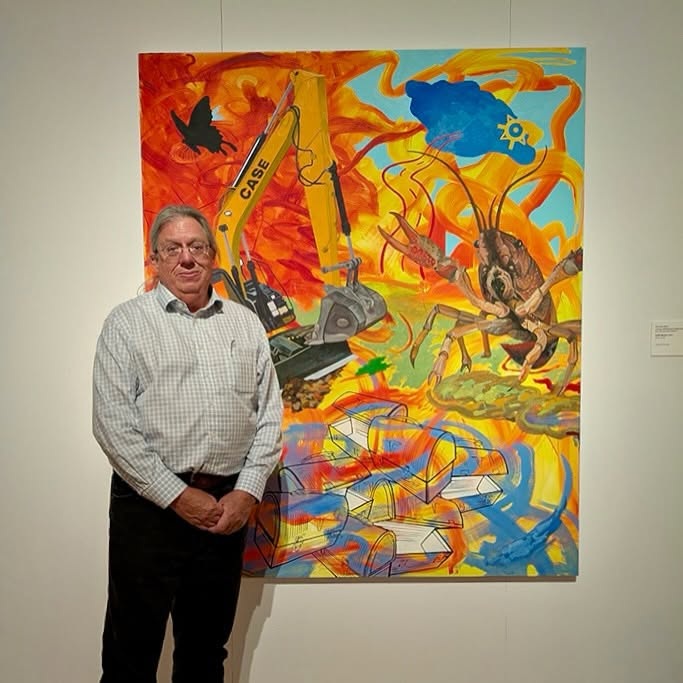
Norman Akers and his piece “Earth Movers.” (Photo by Aileen Wang)
By foregrounding cultural revitalization and Indigenous histories, the day’s breakout sessions continued to celebrate Indigenous resistance. Speakers included Cultural Preservation Officer Tara Mitchell (Prairie Band Potawatomi Nation), Osage language expert Chris Cöté (Osage), artist Taiomah Rutledge (Ojibwe, Meskwaki and Dakota), artivist musician Alex Kimball Williams (Aleut) and K-State librarians and curators of the IndiVoices Project George Gottschalk (Muscogee Nation of Oklahoma) and Thomas Bell. Select moderators and contributors to these sessions share their reflections below.
From Lisa Tatonetti, moderator of the breakouts for Taiomah Rutledge and Alex Kimball Williams:
I had the privilege of moderating two fantastic breakout sessions for K-State’s Indigenous Peoples Day program: Ojibwe, Meskwaki, and Dakota nation artist Taiomah Rutledge’s “Creating Community and Belonging through Art” and Aleut artist, musician, and community researcher Alex Kimball Williams’s “When Art Protests.” There’s so much to say about the powerful work of both artists. Both of these Indigenous intellectuals not only ground their work in the histories of their specific Indigenous nations but also build their practice in and through local community, using art to build bridges and make change.
Taiomah Rutledge discussed how his artwork spans multiple mediums, moving between and among ledger art, print making, and mixed media design and beautification projects in public forums. Rutledge is particularly interested in the pressing environmental issues of the current moment and his art reflects this as he creates images that, for example, he superimposed a gas mask over a black and white photo of a traditionally dressed warrior. His work comments on the pressing current reality of global climate change while simultaneously arising from and employing long-standing histories of Indigenous art. Notably, Rutledge is committed to collaborative practice and to using art to support community. That community could be local families who he involves in culture shares and art making through his work at the Mid-America All-Indian Museum in Wichita or Indigenous artists who he highlights and partners with in his art curation through Artist Inc. and other guest curation work, which has become a central feature of his life and practice.
Rutledge’s fantastic presentation was followed by Alex Kimball Williams, whose work in her musical project Bad Alaskan arises from and supports her strong community leadership. I found striking comparisons between the two artists. While Rutledge might riff off a historical photograph and add a gas mask, Williams builds from Indigenous musical motifs to create contemporary political commentaries through synthesizers and dance music. She joins music together with research and activism. Williams, who coined the genre Indigenous Dance Music (NDM), uses her music and lyrics as activism. In this way, like Rutledge, she extends a long history of Indigenous artistic traditions that blend the power of art — which includes music, painting, and a multiplicity of graphic traditions — with community connection and, at times, the sacred. Williams has been recognized in Lawrence, Kansas for her community organizing and has made significant legislative change through her work. Like Taiomah, Williams is also passionately engaged in contemporary climate issues: she manages an NSF-funded large-scale climate justice grant at Haskell Indian Nations University.
Together, Taiomah Rutledge and Alex Kimball Williams taught us how art, in all its iterations, is an essential part of our present-day communities and the long and deep intellectual traditions of Indigenous nations.
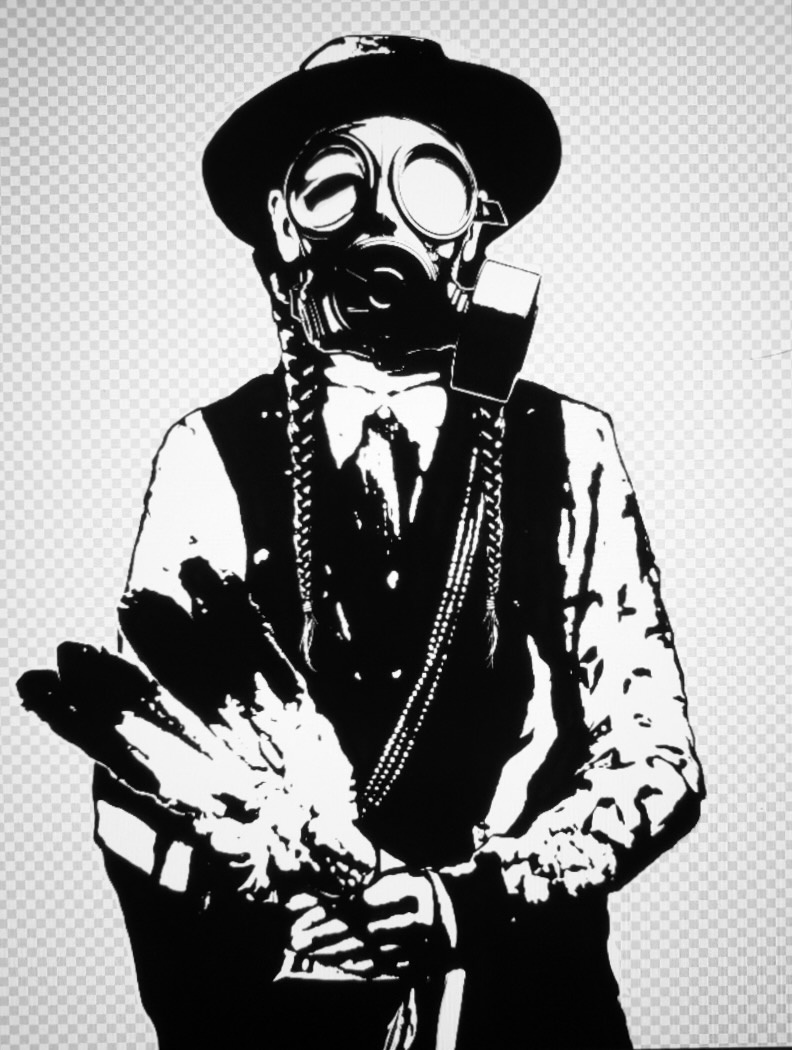
Taiomah Rutledge’s “Home Sick” (Photo by Taiomah Rutledge)
From George Gottschalk and Thomas Bell about their project, IndiVoices:
In our breakout, moderated by LaVerne Bitsie-Baldwin, we discussed IndiVoices, a project that identifies and promotes sound recordings by Indigenous artists, designed to bridge a significant gap left since Greg Gombert’s 1997 Native American Music Directory. Over the past three decades, the landscape of Indigenous American music has undergone a remarkable evolution, with artists breaking new ground in genres as diverse as hip hop and electronic dance music (EDM). As researchers, we found ourselves frustrated by the absence of an updated, accessible compendium, an absence that contributes to the ongoing cultural erasure and marginalization of Indigenous voices. We’ve worked to catalogue the rich tapestry of Native American musical expressions from the late 20th century to the present, through a discography that highlights the vibrant cultural expressions of recorded contemporary Indigenous music. IndiVoices is freely available, inviting engagement, contributions, and collaboration from scholars, artists, and the wider community. Most importantly, our discography exists as a living document, continuously updated to include new artists and works, thereby ensuring that the voices of Indigenous artists are heard and celebrated. The initial contributors have focused on music that is recorded by Indigenous artists who intend the recordings to be shared with a broader audience.
As the IFSA Treasurer and co-organizer of the day—under the leadership of co-chairs LaVerne Bitsie-Baldwin and Toby Holmes—I moderated Chris Cöté’s breakout session, during which he spoke about his contributions to Osage language revitalization, including his translations for “Home/Land: Wahzhazhe Artists Speak.” Previously employed by the Osage Nation Language Department, Cöté is currently studying Cherokee Culture with a focus on language revitalization at Northeastern State University. He created and edited content for the Osage language learning apps “Wahzhazhe” and “Sonny Goes to School” and has worked on the development of language curriculum for the Osage immersion school. Cöté also discussed his work as the Osage language coach and translator for Martin Scorsese’s film adaptation, Killers of the Flower Moon. While Cöté clearly had a rewarding experience coaching performers like Piegan Blackfeet and Nez Perce actor Lily Gladstone (who became so fluent in the language that she improvised Osage lines on set), he reminded viewers that the film is a Scorsese creation, not an Osage film. Côté recommended the Zoom audience turn to works like Smoke Signals, Atanarjuat, and Fancy Dance to experience films helmed by Indigenous-makers and storytellers.
Following the breakout and a brief pause, the evening portion of the celebration took place at the Beach Museum with a meal by Chef Jason Champagne (Red Lake Band of Chippewa), an artist talk from Chris Pappan (Osage, Kaw and Cheyenne River Sioux) and a gallery tour of “Home/Land: Wahzhazhe Artists Speak” led by Aileen Wang. Through his business, Native Chef LLC, Champagne teaches Indigenous communities about health, nutrition, and how to cook sustainably with local foods. Champagne provided a light meal of tacos with lime or wild rice and a choice of beef, pork or chicken. The dessert was pancakes with Wojapi sauce, a traditional Lakota berry sauce.
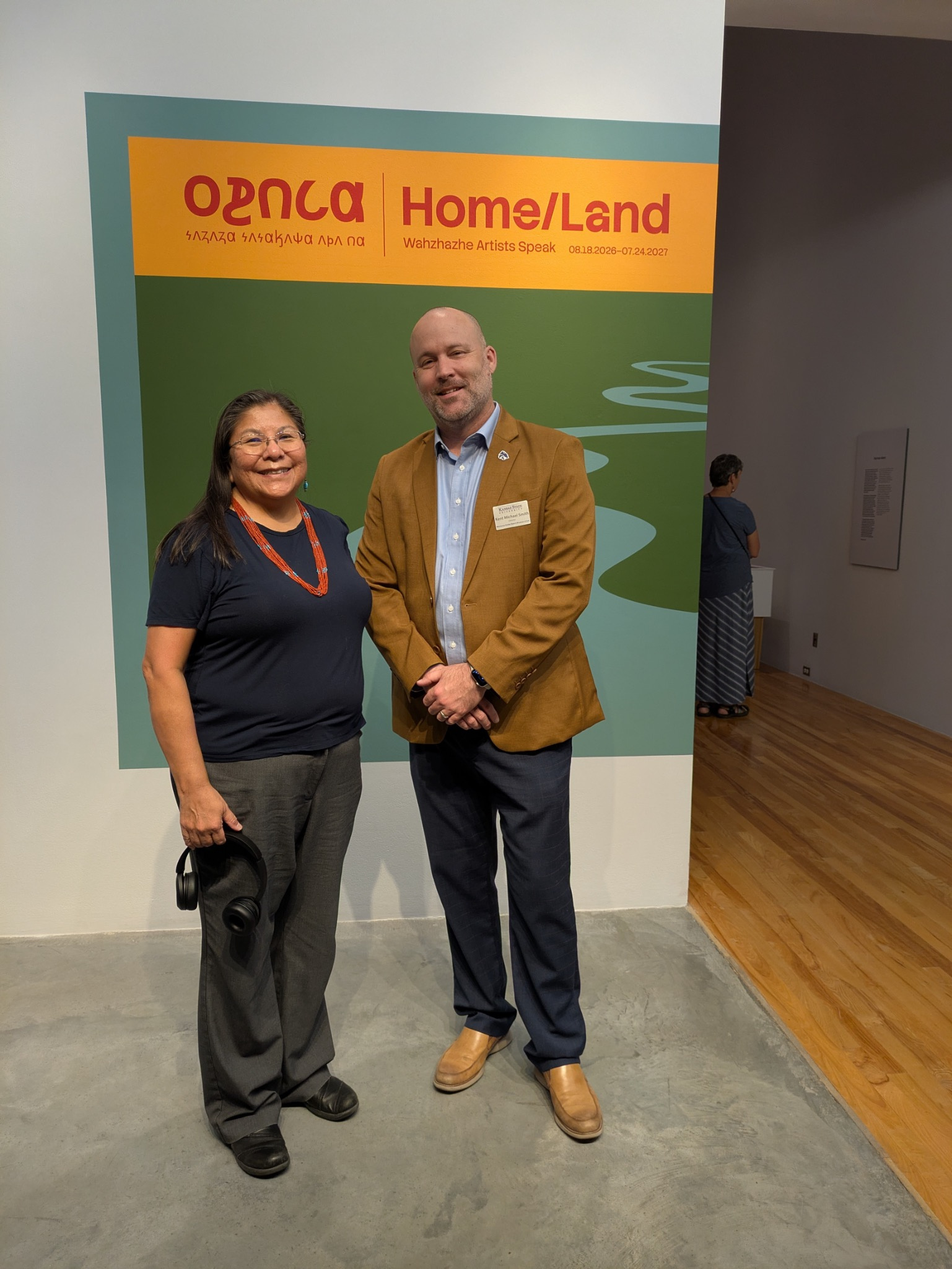
IFSA Co-Chair LaVerne Bitsie-Baldwin and Beach Museum Director Kent Smith.
Energized by Champagne’s meal, Indigenous Peoples Day attendees packed the UMB theatre for Chris Pappan’s presentation.
Pappan is known for his unique approach to the traditional art form known as “ledger art.” Ledger art was produced by Plains Indian war prisoners, who were eager to record their memories of battles, hunts and ceremonies and used existing ledgers to do so in the nineteenth century.
In his keynote, Pappan discussed several of his works and the ways in which they respond to colonialism, asserting Indigenous survivance and history through his reproduction of historic photographs of Indigenous people, rendered on settler ledgers: “In a lot of my work, I try to honor our ancestors. I’m always looking at old photographs, and I feel like I’m communicating directly with them … When I’m creating these works, I’m putting down different layers. I’m starting with the substrate, the ledger paper, and then building on top of that. I’m thinking about what other layers will be added to it later on, whether it’s people looking at it or whether it’s put in a book and going somewhere else.”
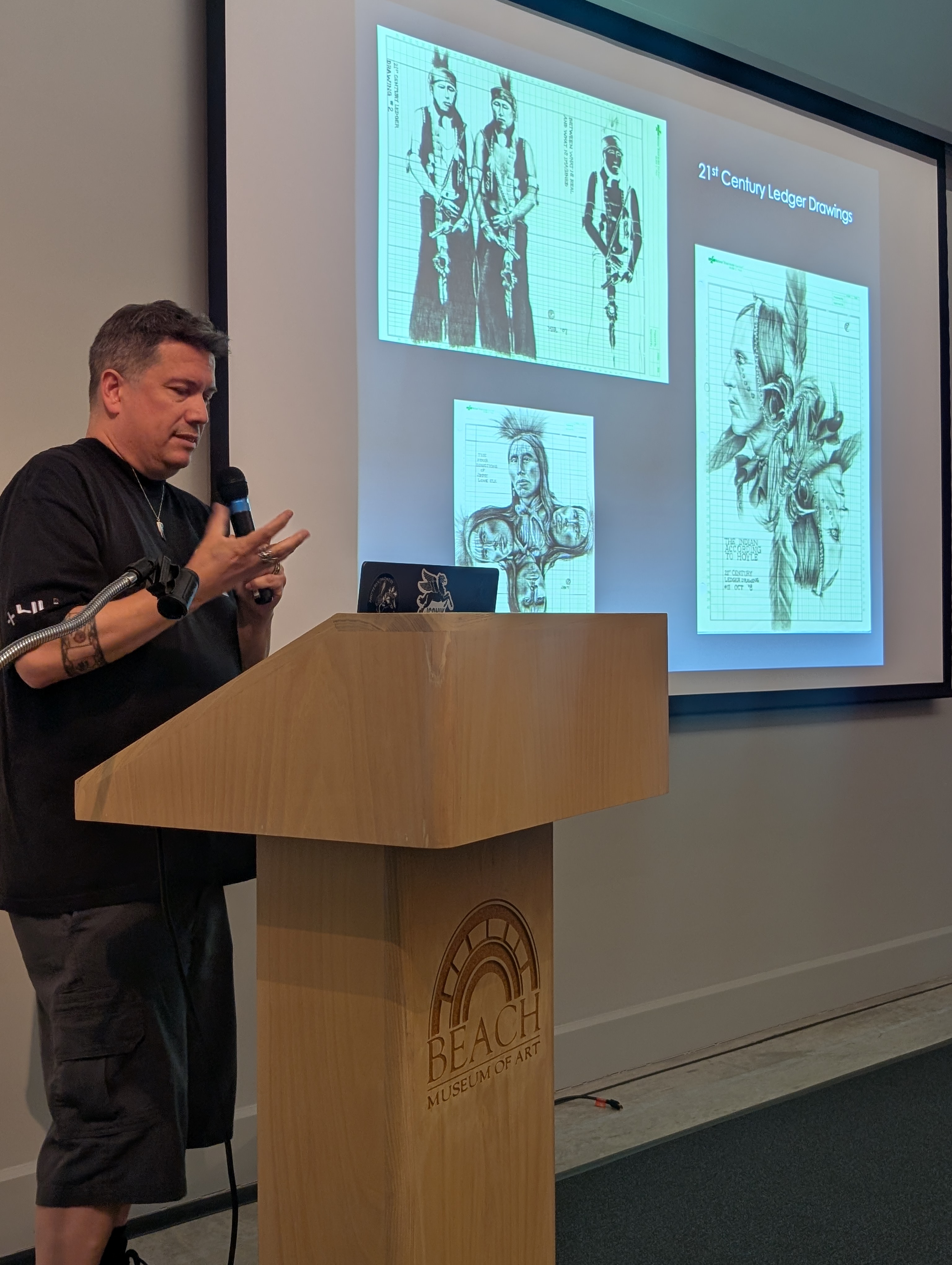
Chris Pappan’s presentation at the Beach Museum of Art. (Photo by Aileen Wang.)
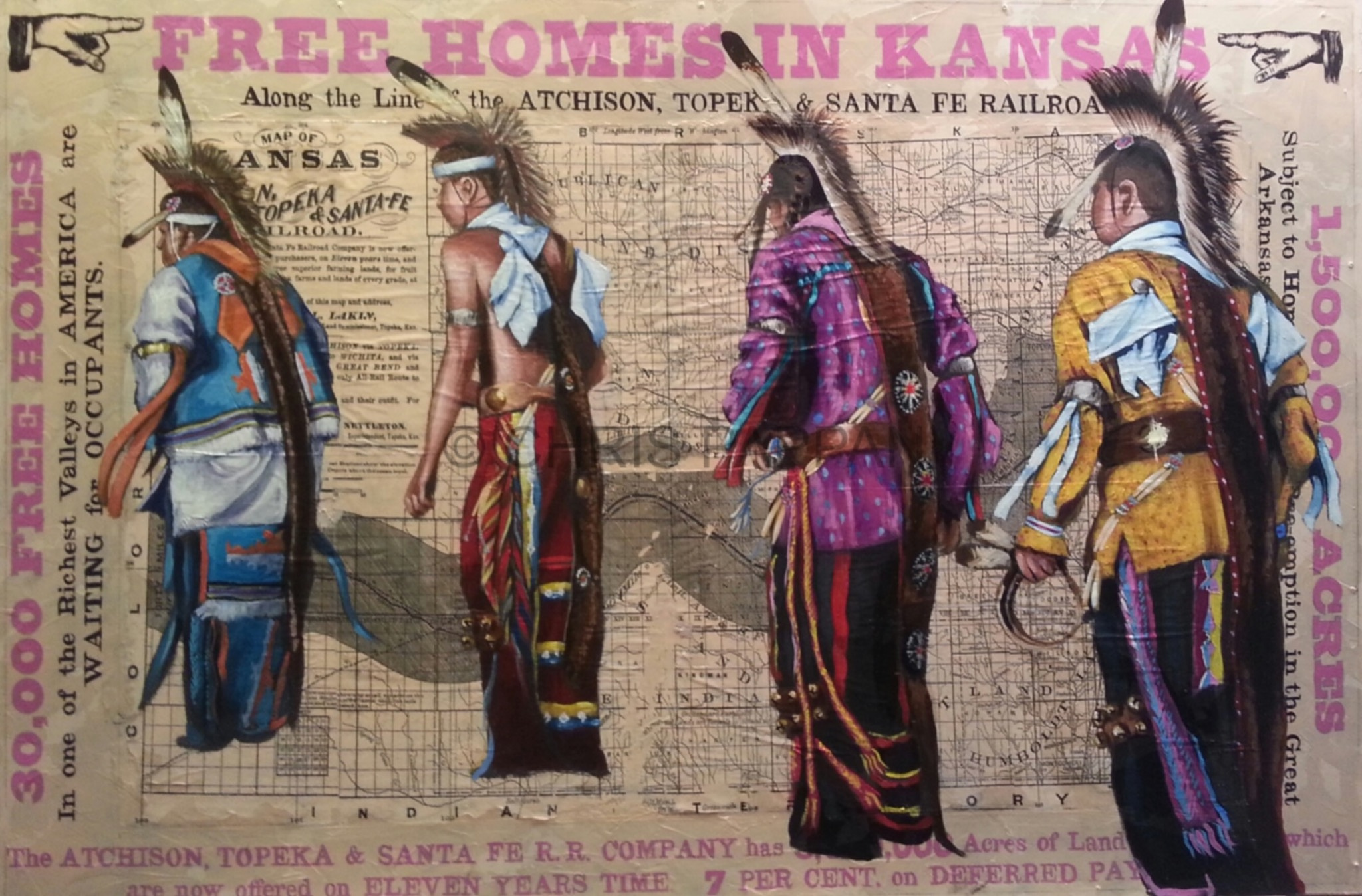
Chris Pappan’s “Occupied Territory” donated to KSU by Haskell University President and previous KSU IFSA Co-Chair, Alex Redcorn. (Photo by LaVerne-Bitsie Baldwin)
KSU student Rowan Anderson forwarded me her thoughts on Pappan’s talk, writing:
In many ways, Chris Pappan’s art spoke for itself. As a Laotian person who has had much of my culture, land, and history erased, I find my own sense of community in similar shared griefs. When I was watching the talk, I didn’t have to dig deep or look far to experience the emotions that were being expressed through Pappan’s art. He told us of how the art came to be, and how it came from his heart, speaking to both his grief and his joy.
As someone closely involved with the planning for Indigenous Peoples Day 2026, I had the distinct privilege of building relationships with many of these artists over the past months. My own reflections on the day are best summed up by the introduction I gave for Chris Pappan at the Beach Museum:
I met Chris on a hot August day in the special collections unit of the library. I watched as he carefully pored over seemingly ancient ledgers, finding gems like a Department of Entomology receipt from 1898. As I watched him work—after taking so much inspiration from what I’d seen online about his art and process—I was overcome by a feeling of hope. We walked and talked that afternoon, on the Kaw, Osage, and Pawnee land now occupied by K-State. Chris acknowledged that we occupy a moment when it’s particularly difficult to be Indigenous, to be different. I came away from our afternoon (and our many conversations since) knowing Chris’s work speaks to Indigenous resilience in an uncertain moment; his art is joy through resistance. His art is hope.
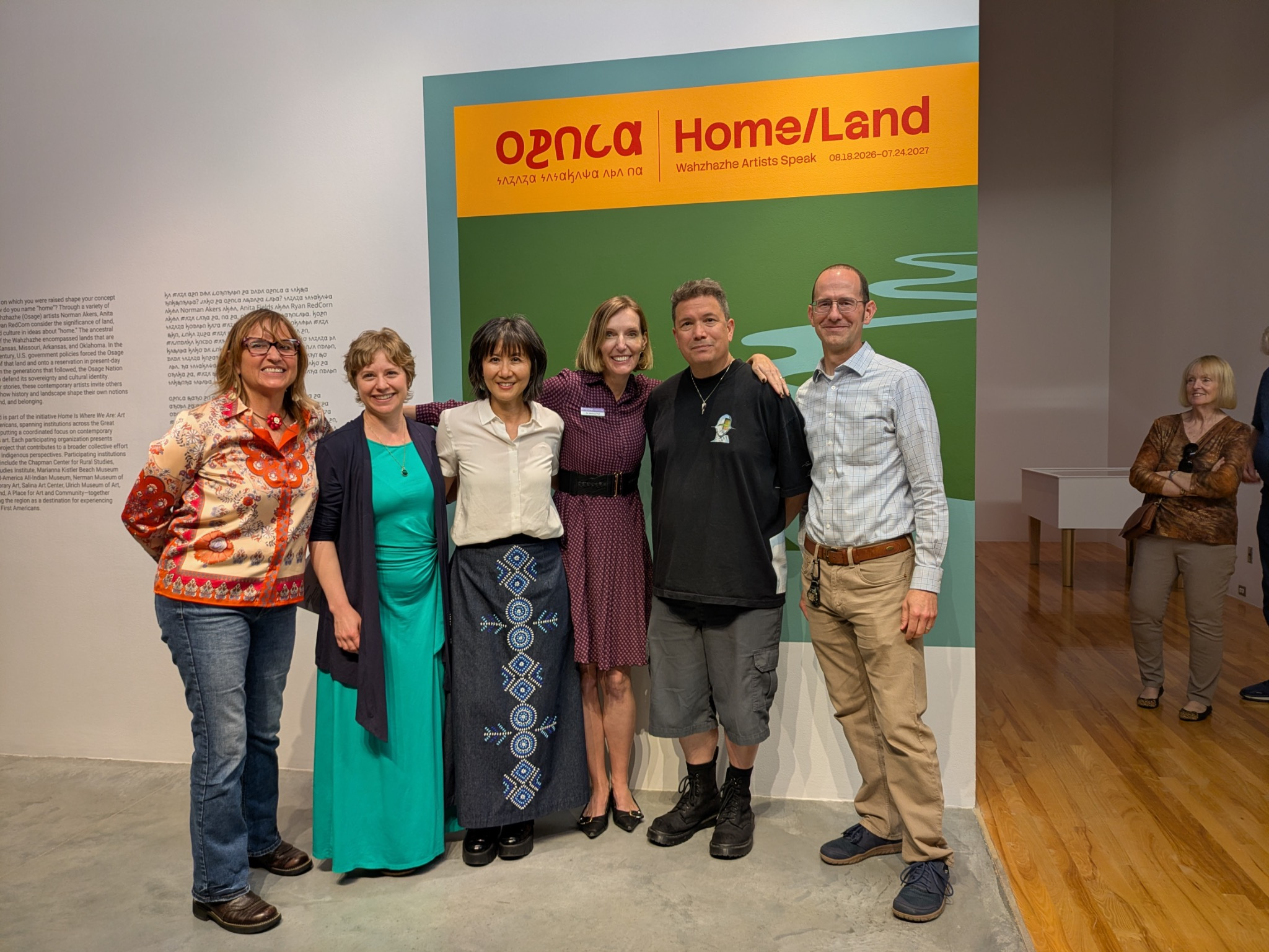
Lisa Tatonetti, Mary Kohn, Aileen Wang, Melissa Poll, Chris Pappan and Cliff Hight at the 2026 Indigenous Peoples Day (Photo by Liz Seaton)
The IFSA and the Marianna Kitsler Museum of Art would like to thank our sponsors:
Arts and Sciences Well-being and Belonging Committee
Chapman Center for Rural Studies
Department of English
Division of Biology
School of Music, Theater, and Dance
Social Transformation Studies
Dow Center for Multicultural and Community Studies at K-State Libraries
Student Access Center
Richard L. D. and Marjorie J. Morse Department of Archives and Special Collections
— Melissa Poll, Visiting Assistant Professor / IFSA Treasurer

