

Last week, ten graduate students from our M.A. program traveled by car to New Orleans to present at the 2025 Popular Culture Association (PCA) conference. Below they share highlights from their presentations and their experience at the conference.
Many thanks to the College of Arts and Sciences and the Graduate Student Council (GSC) for their financial support, so our graduate students can share their scholarship and gain this professional experience!
— Karin Westman, Department Head
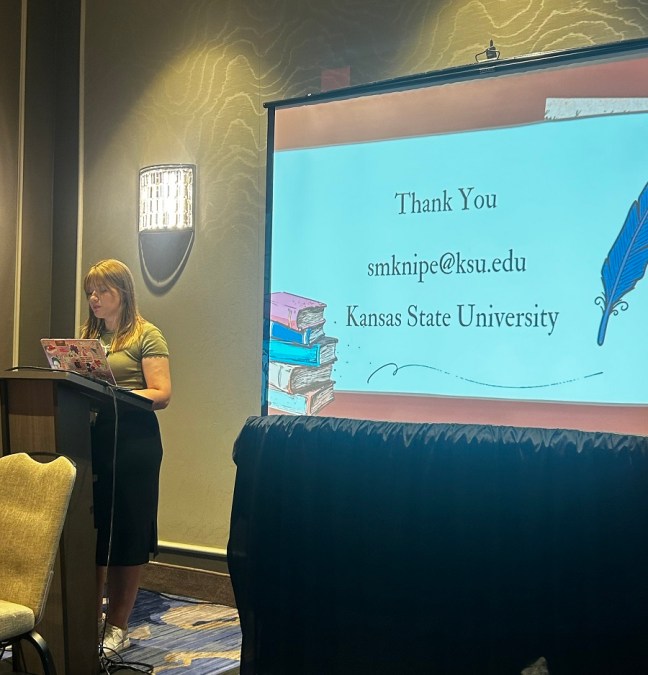
Presentation Title: “Colonial Haunting in Jeff Barnaby’s Rhymes for Young Ghouls: Trauma, Memory, and Haunting”
At PCA I presented a portion of my MA Project, discussing how Jeff Barnaby’s (Mi’kmaq) 2013 film Rhymes for Young Ghouls uses haunting to express colonial violence for both Indigenous and settler characters, playing on fear to bring that same haunting to audiences. Through Tuck and Ree’s “Glossary of Haunting,” I examine the different ways horror and haunting manifest through storytelling in the film and how this haunting impacts the viewer. Specifically, I discussed a scene in which Aila’s grandmother tells her about the story of the Wolf and the Mushrooms, which acts as a metaphor for colonial violence. Through this scene, I focus on the unsettled, both as in the unsettling imagery and story that makes the viewer feel fear and discomfort, and unsettled modes of thought, using scholarship that returns to traditional Indigenous ideologies and thereby complicating settler colonialism’s permeance into all areas of contemporary culture and thought.
My experience at PCA was essential for broadening understandings of my field. Not only did I present my own research, but I was able to network and learn from other notable scholars in my area of study. I even had dinner with the rest of those that presented on Indigenous studies, allowing me to get insight into how my work fits into the broader academic world.
— Sierra Knipe (MA ’25)
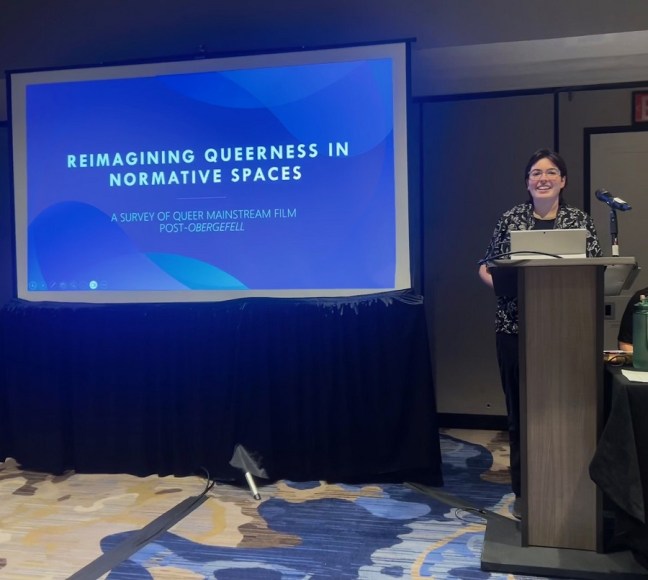
Presentation Title: “Reimagining Queerness in Normative Spaces: A Survey of Queer Mainstream Film Post-Obergefell“
What does it mean for queer people to be on the popular big screen after same-sex marriage has been legalized? Has every gay movie become a gay marriage story? This exploration and analysis of BROS, All of Us Strangers, and Moonlight addresses the curious trend of melancholic gays in modern popular queer film. Despite getting the legal recognition of same-sex unions or even the dream apartment in a bustling, “queer-friendly” major city, the main characters in these films experience loneliness, alienation, and a general ambivalence about romantic love. Through a reading of the queer time and place within these films, a mainstream audience is shown that Obergefell was not the culmination of queer activist work and does not mark an end of the mission for queer legitimacy and non-discrimination in the United States.
This was my second year presenting at PCA, and it was just as fun and enriching as the first! Being able to speak about your work in a room full of people with similar research interests will always be a bit electric—like locking eyes with 30 people in on the same joke, it’s exciting and kind of makes you want to giggle when folks nod their heads and “mhm” at your findings. I found it just as fun to watch my peer’s presentations, though, even when I could tell I was the only one who didn’t quite know about mystery novels or Dracula in the same way as the scholars present. The shared passion in the room alone makes the experience worthwhile.
— Margo Losier (MA ’25)
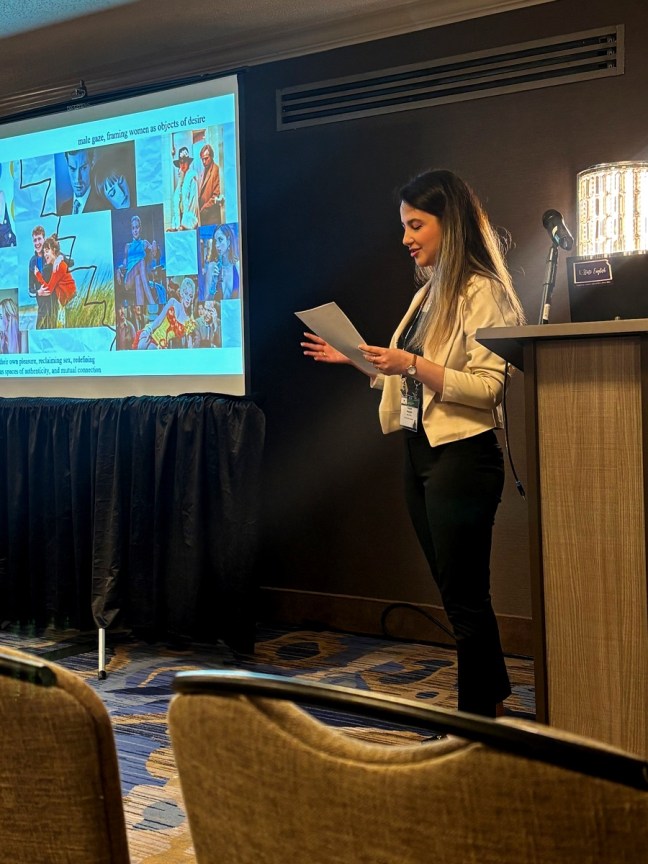
Presentation Title: “Normal People and the Shift Toward Authenticity in Depicting Heterosexual Intimacy”
This presentation examines how Normal People (2020) redefines heterosexual intimacy in contemporary media. The Hulu series portrays intimacy with emotional depth and realism, challenging traditional tropes that glorify male dominance and female submissiveness. Instead, it centers consent, mutual respect, and emotional vulnerability. Marianne drives this shift. Her insecurities and complexity break from the idealized female characters often found in Hollywood. The series treats intimate scenes as narrative essentials rather than eroticized add-ons, using them to expose the emotional and psychological layers of Marianne and Connell’s relationship. Female creators and an intimacy coordinator play a crucial role in shaping these ethical, authentic depictions. The show doesn’t just reflect change; it pushes the industry toward more honest storytelling. By focusing on realism, gender dynamics, and emotional authenticity, this presentation argues that Normal People captures a cultural turn in how modern television represents heterosexual relationships—less performative, more human, and far more relatable.
My experience at PCA was incredibly rewarding. Presenting alongside professors on my panel felt intimidating at first, but it ultimately boosted my confidence, especially when they praised my work and engaged with it through thoughtful questions. I had the chance to meet many people and build valuable connections in my field. Attending other panels was equally enriching. I appreciated the wide range of diverse and thought-provoking topics that were presented. Overall, it was an inspiring and affirming experience.
— Faezeh Rostami (MA ’26)

Presentation Title: “The Yassification of the Midwest: Subverting Midwestern Cultural Fashions & Redefining Queer Spaces”
Though the Midwest has long been perceived as an environment unwelcoming to queer folx, that does not mean they do not create space for themselves in the heartland. Much of Midwestern fashion is not just associated with the region itself— it also has problematic ties to patriarchy, bigotry, and white supremacy. Ironically, though queer folx have had to utilize social camouflage as a means of avoiding discrimination by blending into heteronormative culture, they are reclaiming the camo pattern and a number other fashions commonly associated with an often conservative, homophobic culture and queering it. In an act of resistance against harmful power structures and in fabulous form queer folx of the Midwest have applied elements of camp and drag to camo print clothing, western wear, NASCAR merch, and Bass Pro Shop hats, subverting their associations with harmful ideologies and redefining them as symbols of celebration that welcome queerness into Midwest culture.
— Zoey Dutcher (MA ’25)
Presentation Title: “Guilt by Design: The Media’s Rhetorical Construction of Guilt in the Casey Anthony Trial”
My presentation explores how media rhetoric can influence public perception of guilt in high-profile criminal cases, using the Casey Anthony trial as a case study. While the court acquitted Anthony due to insufficient evidence, the media launched a parallel trial in the court of public opinion, portraying her as guilty through emotional framing, moral judgment, and rhetorical strategies. My research investigates the specific factors that shaped this media narrative, particularly the perceived failure of maternal expectations and moral deviance. I argue that Anthony’s criminalization was rooted in cultural anxieties about motherhood, which led to a denial of space for sympathy and a dismantling of her character in the court of public opinion. Through this analysis, the presentation reveals how rhetorical techniques in media coverage can undermine legal outcomes and contribute to the public’s distrust in the justice system.
I was unexpectedly asked to serve as a panel chair, where I introduced speakers, moderated the Q&A session, and completed a closing reflection. Though unplanned, I embraced the role and am proud to have delivered it successfully. PCA was a really great experience for my professional growth, and I am glad to have attended.
— Fortune Lavie (MA ’25)

Presentation Title: “Two-Penny Ale or Fine Burgundy?’ Publication History and Initial Reception of Wilkie Collins’ The Moonstone“
An examination of the publication history and initial reception of canonical literary works often reveals notions and ideologies that are not usually obvious to the modern-day reader. When Wilkie Collins wrote The Moonstone in 1868, little did he know of how he was setting the tone for and contributing to what would later become the conventions of detective fiction. Although the novel is now well admired, there were varying perspectives on The Moonstone when it was first released. This paper examines in-depth an early critique of The Moonstone and highlights how that critique shapes our understanding and interpretation of The Moonstone as one of the pioneer detective fictions.
It was my first time attending PCA, and I was very excited to participate in the conference. I presented my research and also attended sessions that were interesting to me. Aside from the fact that members of the audience asked insightful questions after my presentation, it was interesting to get a glimpse of other scholars’ perspectives on topical issues. The conference offered me a great learning experience as well as an opportunity to connect with like-minded individuals!
— Mary Adeyemo (MA ’26)
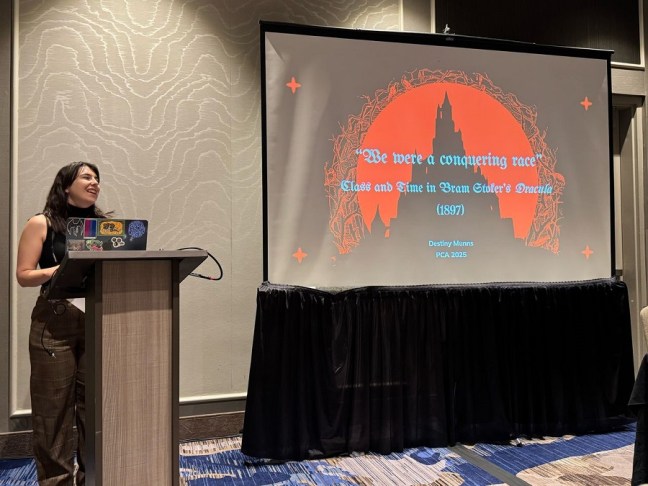
Presentation Title: “‘We were a conquering race’: Class and Time in Bram Stoker’s Dracula (1897)”
In my presentation, I argue that in Dracula, Stoker aligns Dracula with both the Eastern feudal aristocracy and the modern English aristocracy. With this connection, Stoker offers a critique of the English aristocracy and their leechlike dependency on the working class’s labor. I begin by explaining how Thomas Carlyle’s critique of the aristocracy demonstrating contemporary declining opinion towards the noble class. I then explain how Stoker’s descriptions of Dracula’s physical characteristics evoke the Victorian pseudosciences of phrenology and physiognomy to depict Dracula as being both criminal and aristocratic. My presentation also investigates the many uses of blood and the novel, especially the relationship between kin blood ties and the vampiric feeding on blood. Finally, my presentation explores the anxieties of the aristocracy corrupting the lower classes through Dracula’s relationship with Lucy Westenra.
It was a great experience to meet people with similar scholarly interests and make connections. It was also really interesting to attend the panels of my cohorts and see them present. New Orleans is also an amazing city with great food and music and out conference was right in the center of the excitement in the French Quarter.
— Destiny Munns (MA ’25)
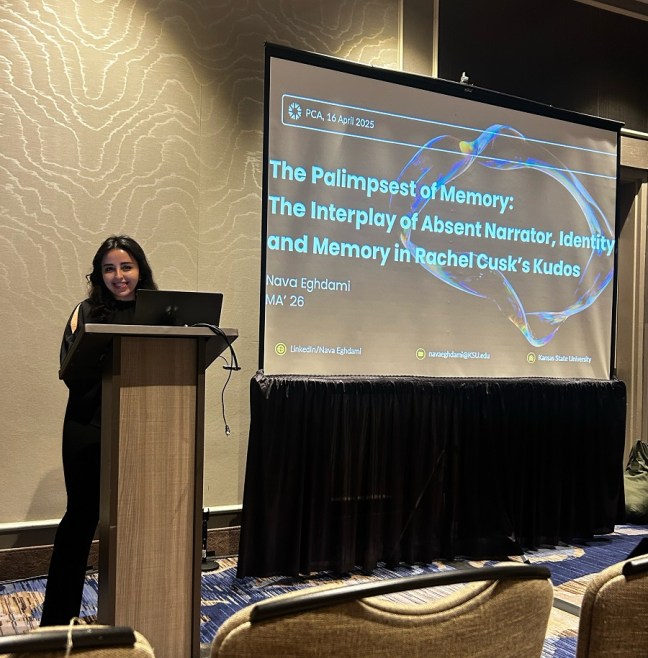
Presentation Title: “The Palimpsest of Memory: The Interplay of Absent Narrator, Identity, and Memory in Rachel Cusk’s Kudos“
Imagine a story in which you are the protagonist, yet you largely remain silent, not because you have nothing to say, but because you are content to listen. A story where the boundaries of selfhood blur, where memory is not a fixed, singular truth but a fluid and ever-changing narrative constructed through conversations, observations, and reflections. Now, this is exactly what Rachel Cusk’s Kudos, the final novel in her trilogy called The Outline, offers its readers. In this innovative autofiction, the protagonist, Faye, is not the center of the story; she is an observer, a listener, and a mirror through which the identities and memories of others are reflected. Through Faye’s role as an “absent narrator,” Cusk makes us reconsider fundamental questions about identity and memory. What happens when the central character is not the architect of the narrative but instead the one who absorbs and reinterprets the stories of others? How do we come to understand ourselves, not through introspection, but through the stories we hear and the lives we encounter? This is what I argue: that in Kudos, Cusk does not simply tell us about memory and identity; she shows us how they are continually constructed, deconstructed, and reconstructed in the space between people. In short, I argue that the depiction of the fluidity of memory in Cusk’s Kudos defines the relationship between narrative absence and the formation of identity in contemporary autofiction.
This was my very first in-person conference experience, and despite facing the challenge of an 8AM panel on the opening day (who needs coffee when you have adrenaline?), I managed to get the most out of this journey. After my presentation, I had the opportunity to engage with attendees who shared their own interpretations of memory and identity in literature. The exchange of ideas was invigorating, and I found myself challenged and inspired by perspectives I had not considered before. It was simply a beautiful reminder that literature is not just a solitary endeavor; it thrives in the dialogue it fosters among readers and scholars alike. I also got to meet Katie Cline (MA ’20), who used to be a grad student in English at KSU, and is now furthering her research and career.
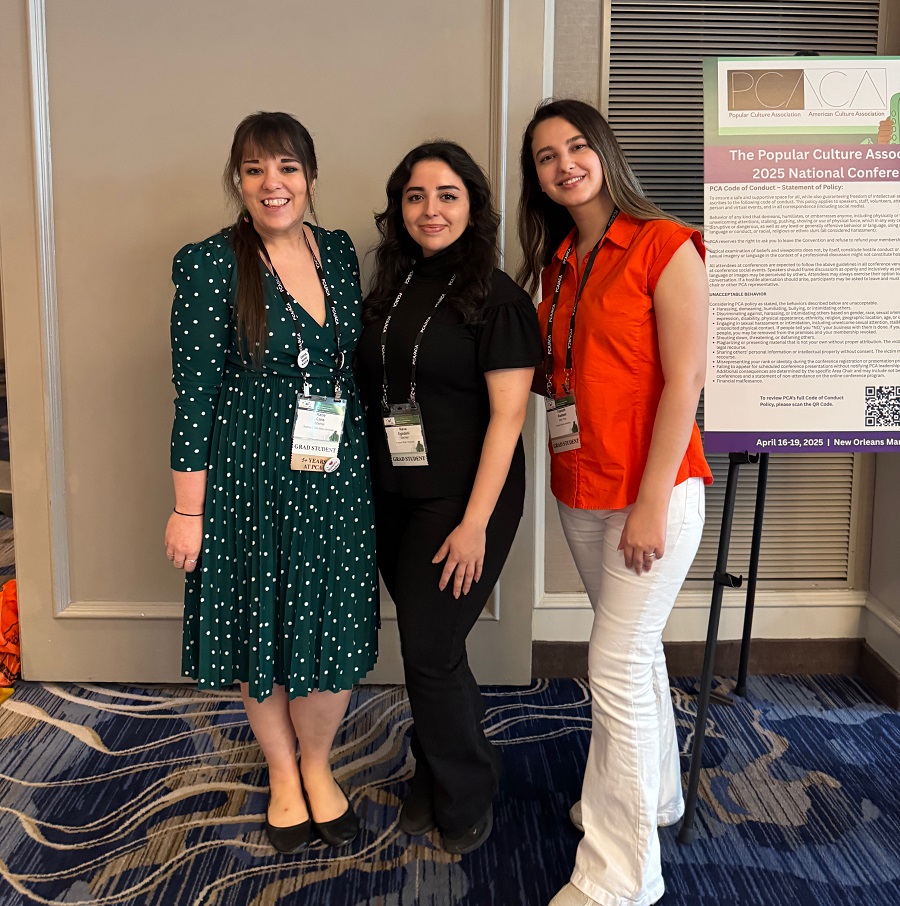
This made me feel so proud and grateful for the path I took, and hopeful for the future that will come along.
— Nava Eghdami (MA ’26)

Presentation Title: “Taste of Cherry, a Film by Abbas Kiarostami”
Presenting at PCA was a truly meaningful experience for me—it was my very first academic presentation, and I’m incredibly proud that I got to share a part of Iranian culture with an international audience. I presented Taste of Cherry, a film by Abbas Kiarostami, which was the first Iranian film to win the Palme d’Or at Cannes. This film carries profound philosophical questions about life and death, and sharing its depth and beauty with others sparked powerful conversations.
What made the experience even richer was the chance to connect with people from all over the world—hearing different perspectives, exchanging ideas, and feeling part of a global community of thinkers.
New Orleans, the host city, was unforgettable. It’s full of color, music, and soul. The energy of the streets, the sound of jazz, the historic architecture—it all made the trip even more special.
Through this presentation, I also reflected on my own perspective toward life—how cinema and culture shape the way I think, feel, and connect with others. It was more than an academic experience; it was a personal journey.
We drove all the way to New Orleans, and even though the trip was long, it was so rewarding. I got to see the natural beauty of different states along the way, and that sense of freedom and exploration added another layer to the experience. I’m truly happy and grateful for having had this opportunity—something I’ll always carry with me.
— Hoora Ghanbari Adivi (MA ’26)
 K-State English