
Today we share the fourth of six pieces of public writing selected for publication from an assignment in ENGL 801 “Graduate Studies in English” — and the first selection from Section A of ENGL 801, taught last fall by Cameron Leader-Picone: a piece of public scholarship (700-1,000 words) which tailors an academic paper and its scholarly intervention of 10-12 pages for a general-interest audience.
Read more about the assignment and the first publication, “Who is Writing?” by Mizanul Bari (MA ’27), in the post from December 11, and enjoy the subsequent posts: “Localization: Some Local Nonpharmaceutical Interventions During the COVID-19 Pandemic in Ghana” by Daniel Effah (MA ’27), “Why You Should Read the Comments of Paris Paloma’s ‘Labour’: Everyday Work, Capitalism, and Unrecognized Emotional Labor” by Ruth Okon (MA ’27), and “Anxiety and Aesthetics: The Frutiger Aero Aesthetic” by Sydney Kelso (MA ’27). Now, on to “Why Can’t the Trans Man Also Be a Racist A**hole?” by Vivian Marshall (MA ’27) —
— Karin Westman, Professor and Department Head / Instructor for ENGL 801 B/ZA (Fall 2025)
If you’ve ever felt disappointed by the way an adaptation of an existing work changed a character you love – like they were watered down, defanged, or otherwise misunderstood and misrepresented – how did you make sense of those poor decisions? A rushed production schedule? Corporate meddling? A premature killing of the original authors?
If the character you thought of is part of a historically marginalized minority group, even if it seems like that group has gained some mainstream acceptance in recent years, they could have been motivated by secondary marginalization, a concept explored by Cathy Cohen, an American political scientist, in her book The Boundaries of Blackness.
According to Cohen, once a minority group has gained some ostensible acceptance in society, their marginalization shifts from more overt forms such as legal discrimination to more covert ones. One of these covert forms is the aforementioned secondary marginalization, where the group is portrayed as being “just as good as” non-minorities with the justification that they adhere to dominant societal values such as agreeableness and egalitarianism to a greater extent than them. Non-minorities, meanwhile, aren’t held to the expectation to adhere to those values to the same extent, and thus minority groups are held to an elevated standard of decorum.
This standard doesn’t just hold for real people: characters in the group are also expected to be well-behaved ambassadors for it, models of “correct” behavior for minority group audience members, offering reassurance of the minority groups’ nonthreateningness for non-minority audience members.
The 1961 and 2021 film versions of West Side Story offer a great example of this process.
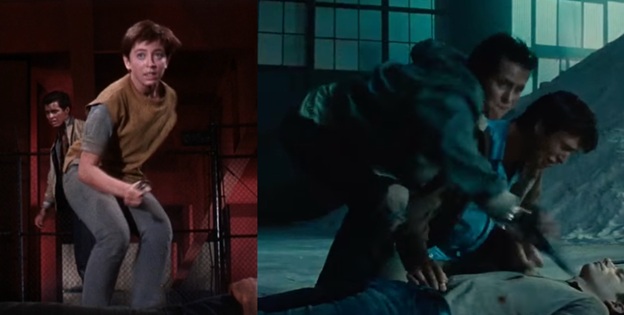
While the former allows the trans man/boy and aspiring Jet Anybodys to have a realistically aggressive and a**holish personality like the cis male teenage hooligans he perpetually attempts to fall in with, the 2021 movie softens his characterization so that he can model “correct” behavior, even though this watering down clashes with his role in the story, his established characterization, and common sense. When characters are used to perpetuate secondary marginalization in this way, it hurts not only the real-life minority group, but also the works that they’re from.
You might have heard that the 2021 West Side Story made a tomboy character into a trans man, but that’s not entirely accurate. It’s important to keep in mind that the 1961 movie was made when the Hays Code was in effect, meaning that it wasn’t possible for it to be released with overt depictions of queerness. Just like it managed to all but confirm that Tony and Riff are not entirely straight with the sexual way Tony wrestles him to the ground outside Doc’s shop, though, it clearly portrays Anybodys as trans. When the threat of possibly being shot by Chino alongside his friend Tony doesn’t deter Anybodys from trying to help him, but Tony calling him a girl does, he’s not being coded as a tomboy. He’s being coded as a trans man who understandably reacted negatively to being misgendered by a friend but could use more self preservation instinct.
The 2021 movie, being well out from under the shadow of the Hays Code, has the liberty to make Anybodys’ transness something that he quite colorfully directly states (“I said I ain’t no goddamned girl, ya shriveldick dago pansy!”) rather than something that’s left in the realm of (still obvious) coding. Unfortunately, that release from the shackles of the Hays Code didn’t correspond with Anybodys keeping his aggressive, confrontational, teenage-boy-typical personality in any scene besides the aforementioned “shriveldick dago pansy” one. While the 1961 version of the character takes a knife from the rumble with him and gleefully participates in the Jets’ harassment of Anita up until it takes a turn towards sexual assault, the 2021 version fearfully casts the knife away from him and peacefully warns Anita of the attempted sexual assault long before it happens.
Why didn’t the screenwriter and director of the 2021 version, Tony Kushner and Steven Spielberg, put equal care into authentically writing Anybodys’ personality as they did into authentically writing him as a trans character (Chichizola)?
That question can be answered with the concept of secondary marginalization.
Research shows that male characters in films are disproportionately portrayed as having stereotypically aggressive, active, and masculine traits while female characters are shown as having stereotypically peaceful, passive, and feminine traits (Haris et. al.) and that women and female characters are held to higher standards of morality than their male counterparts (Quratulain et. al.). Not only is Anybodys in the 2021 movie as a trans man/boy held to a higher standard of decorum and non-awfulness-as-a-person than the racist, violent cis men/boys in the gang he wants to join, but he is also held to the standards of decorum for his assigned gender at birth.
Under the Hays Code, Anybodys’ transness had to remain in the realm of subtext for it to be allowed in a published film, and in 2021, it had to be tempered with implicit (though probably not consciously created) reassurances to the audience that it doesn’t mean he or the real life trans people he stands in for will step outside of the expectations for the gender they’re “supposed” to be or otherwise stray from a rigid adherence to dominant societal values. In addition to hurting real life trans people, this shift in his characterization weakens the 2021 film. Because trans men are men in the same way as cis men, the fact that Anybodys’ behavior and personality no longer align with those of the cis male Jets is confusing and weakens the strength of the characterization in the movie as a whole. That is, it’s confusing unless viewers take into account the secondary marginalization that drove these changes in his characterization.
If the established pattern for releases of West Side Story movies holds, this 2021 characterization won’t be replaced with a better and less harmful film one until around 2081 or so. Until then, writers can combat the secondary marginalization that drove this shift in characterization by allowing trans and other minority group characters to be complex, flawed people just like their non-minority counterparts.
Chichizola, Corey. “West Side Story’s Iris Menas on the ‘joyful’ Collaborative Process Bringing a Transgender Anybodys to Life.” Cinemablend, Future US Inc, 22 Dec. 2021, www.cinemablend.com/interviews/west-side-storys-iris-menas-on-the-joyful-collaborative-process-bringing-a-transgender-anybodys-to-life.
Cohen, Cathy J. The Boundaries of Blackness: AIDS and the Breakdown of Black Politics. University of Chicago Press, 1999.
Haris, Muhammad Junaid, et al. “Identifying gender bias in blockbuster movies through the lens of machine learning.” Humanities and Social Sciences Communications, vol. 10, no. 1, 10 Mar. 2023, https://doi.org/10.1057/s41599-023-01576-3.
Quratulain, et al. “Selective Morality and Gendered Double Standards in Thomas Hardy’s ‘Tess of the D’Urbervilles.’” International Journal of Social Science Archives, vol. 6, no. 3, Dec. 2023, pp. 173–178, https://www.ijssa.com/index.php/ijssa.
Robbins, Jerome and Robert Wise, directors. West Side Story. United Artists, 1961.
Spielberg, Steven, director. West Side Story. 20th Century Studios, 2021
— Vivian Marshall (MA ’27)

